

Your agent needs to read and write Postman. Postman ships a hosted MCP server and a full REST API, and the two are not interchangeable. They expose different tool surfaces, sit on different auth models, and carry different operational cost in production. The interesting part is that Postman is one of the few tools where the MCP path, not the API, is the one that got modern OAuth. Here is how to pick.
Both are official Postman surfaces for programmatic access. One is built for agents and natural-language tool calling; the other is the raw platform API. Knowing exactly what each one is sets up every tradeoff that follows.
The Postman MCP server connects AI agents to your Postman workspaces, collections, environments, specs, and mocks, and translates natural-language commands into Postman API workflows behind the scenes. It runs as a Postman-hosted remote server over streamable HTTP, or as a local server over STDIO through the @postman/postman-mcp-server npm package or a Docker image. The remote server offers four tool configurations: minimal (the default), code, full, and learn.
Tool counts matter for agents, so they are worth stating precisely. The default minimal configuration provides 37 tools; the full configuration exposes all available Postman API tools, which Postman documents as 106. You can read the setup and configuration details in Postman's official MCP server documentation.
The Postman API is the REST platform underneath everything Postman does: collections, workspaces, environments, specifications, mocks, monitors, webhooks, and the administrative surfaces on Team and Enterprise plans. Every MCP tool ultimately calls one of these endpoints, plus a large surface the MCP server never touches.
Authentication is a single model. You send a Postman API key in the X-API-Key header on every request; Enterprise admins can manage those keys at scale, set expiration windows, and issue keys against system service accounts. The endpoint list and auth details live in the Postman API reference.
The comparison runs across four dimensions that decide whether a path survives production: what the agent can do, how it authenticates, what you own operationally, and when each one is the right call. Each is specific to Postman, not generic MCP advice.
The default MCP server covers the authoring core: collections, requests, workspaces, environments, specs, and mocks. Monitors move into the full configuration, code generation lives in the code configuration, and administrative surfaces stay on the REST API. The table below maps the actions that matter most for Postman agents.
The gap is not that the MCP server is weak; it is that its default surface is deliberately small and its full surface is still a curated subset. An agent built against the minimal default silently lacks monitors, webhooks, and every administrative endpoint. Turn on the full configuration and you gain breadth, but you also hand the model 106 tools to choose from. As explored in MCP is up to 32× more expensive than CLI, token costs from large tool surfaces add up fast. The REST API, by contrast, is complete and versioned, at the cost of you writing every call yourself.
For most tools in this series, the MCP server is the OAuth path and the API offers keys. Postman inverts that, and the inversion is the single most important fact for agent builders. State it plainly: on the US remote MCP server, OAuth is the recommended method and fully compliant with the MCP Authorization specification, with an API key as an optional fallback. The EU remote server and the local server support Postman API key authentication only.
The direct REST API has no OAuth path at all. Every call carries a Postman API key in the X-API-Key header, scoped to whatever the key's owner can access. Enterprise plans add key expiration, a key-management dashboard, and system service accounts, but the credential type never changes: it is a long-lived key.
Both paths require per-user credential isolation in a multi-tenant B2B agent, and neither path gives it to you. The MCP OAuth flow gives you a token per user; the direct API gives you a key per user. In neither case does the path itself solve storage, rotation, or revocation. Those are infrastructure problems regardless of which path you choose, and they are where a shared Postman API key quietly turns every agent action into the same service-account identity. This is a core pattern explored in credential ownership across agent tool-calling patterns.
With the hosted MCP server, Postman owns the infrastructure, the endpoint normalization, and the tool schemas. That is real operational relief; you do not run a container or patch a server. What you still own is token storage per user, the configuration drift between minimal and full across deployments, and the schema churn when Postman ships server updates that rename or restructure tools.
With the REST API, you own the entire stack: endpoint selection, request construction, pagination, retries, error handling, and the full key lifecycle. The tradeoff is stability. REST endpoints are versioned and change on a documented cadence, so a nightly governance pipeline calling the same handful of endpoints is not exposed to an MCP server update reshaping a tool signature underneath it.
The decision is rarely about capability alone; it is about the shape of the agent. Two clear lists cover most real cases.
Use Postman MCP when:
Use the Postman REST API when:
The auth divergence between the two paths is real: OAuth 2.1 for the remote MCP server, API keys for everything else. That divergence obscures the problem sitting underneath both choices, and it is the problem that actually breaks in production.
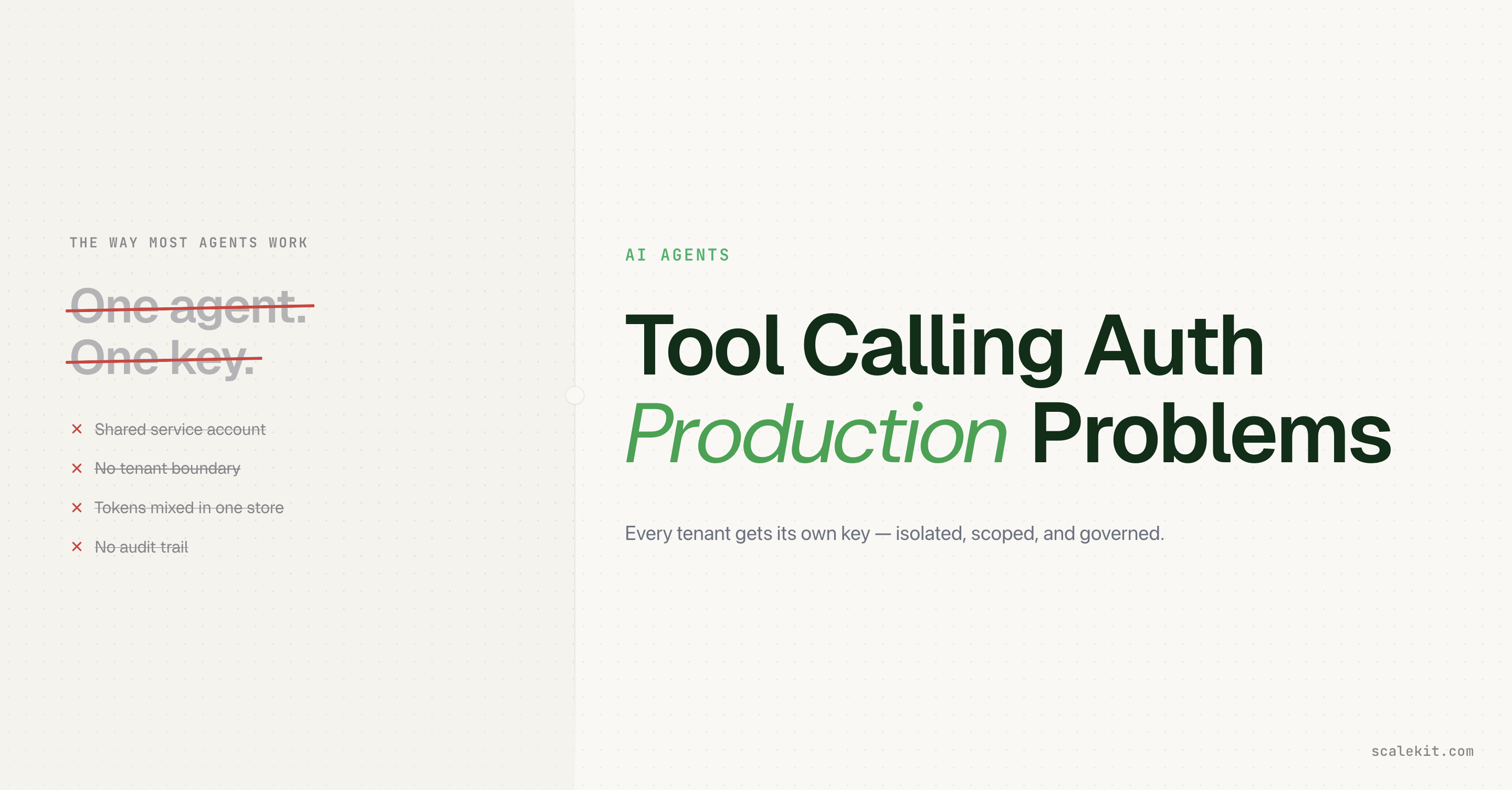
Both paths produce a credential per user. The MCP OAuth flow issues a token per developer; the REST API issues a key per user or service account. Neither one gives you a vault, a rotation schedule, or a revocation flow. In a multi-tenant B2B product that is N credentials, one per user, each with its own lifecycle, and each a live path into a customer's Postman org if it leaks. A shared key looks fine in a demo; in production every collection edit and every mock change is attributed to one identity, and your audit trail is already broken. The operational weight of this is covered in depth in secure token management for AI agents at scale.
Scalekit's Postman connector handles the OAuth 2.1 or DCR flow, stores each user's credential in an AES-256 vault resolved at request time and never exposed to the model, and scopes the tool surface per user, so the MCP versus API decision does not change your auth infrastructure. You can see the connector in the Scalekit Postman connector docs and on the Postman connector page.
Scalekit's Postman connector wraps the official Postman MCP surface behind a per-user identity model. The connector slug is postmanmcp, and its tools carry the postmanmcp_ prefix, for example postmanmcp_getworkspaces and postmanmcp_createcollection. Start by installing the SDK and setting your environment credentials.
Install the AgentKit SDK for your stack and initialize a client with your Scalekit environment credentials.
Before an agent can act, the individual user authorizes their own Postman account once. Scalekit runs the OAuth flow and vaults the resulting credential against the user's identifier.
This step is the difference between a per-user agent and a shared-credential one. The agent does not receive the full connector catalog; it receives only the tools the current user's connected account is authorized to call. That surface reduction is both an accuracy lever and a cost lever: 106 full-configuration tools at roughly 200 tokens each is more than 20,000 tokens spent before the agent does any work.
With the authorized surface loaded, the agent executes a specific Postman tool. Every call runs as the user who authorized it, so attribution and scope stay accurate.
For a framework agent, the LangChain adapter returns the scoped tools as native StructuredTool objects, so you register real Postman tools without hand-writing schema conversion. The agent loop is standard LangChain from here. For a broader look at how LangChain handles tool calling, see LangChain Tool Calling: How It Works, Where It Stops, and How Scalekit Completes It.
The single-connector setup above is enough for one Postman agent. The moment you add a second tool or a second tenant, the operational questions change, and this is where Scalekit's infrastructure earns its place.
A standard MCP server exposes every tool it has; the full Postman server surfaces 106. A collection-sync agent needs a handful. A Virtual MCP server lets you declare exactly which Postman tools an agent role can see, then serves every user from one static endpoint while minting a short-lived session token scoped to that specific user's connected account before each run. You configure the connection and the tool allow-list once; there is no MCP server to deploy, host, or maintain. The details are in the Virtual MCP overview.
The endpoint is static; the identity is not. Because the allow-list is set per agent role, a spec-review agent can be limited to read and sync tools while a workspace-provisioning agent gets create and update tools, and neither can reach beyond what you allowed. What the user cannot do, the agent cannot do, and what you did not allow, the agent never sees. This is the same least-privilege principle at the heart of access control for multi-tenant AI agents.
Per-user identity is only useful if you can see it. Scalekit records every downstream tool call with full attribution: who authorized the credential, which agent ran the call, which Postman tool executed, and what came back. Those logs are exportable to your SIEM with failures separated by source, which is the difference between an audit trail that names user_123 and one that names a shared service account. Understanding what good agent observability looks like is covered in Agent Tool Observability: Your Agent Is Running. Is It Actually Working?
The choice tracks the shape of the agent, not a ranking of the two surfaces. Both are official, both are maintained, and both leave the hard part to you.
If your agent is developer-facing and interactive, a coding assistant syncing collections and specs from an editor, the Postman MCP server is the right call: OAuth on the US remote server, Postman-maintained schemas, and a fast path to a working tool call. If your agent is headless or administrative, running scheduled monitors, governance checks, webhook management, or anything on the Enterprise surface, the REST API is the only complete path, and you accept owning the full request and key lifecycle in exchange for versioned stability.
The single question that decides it: does your agent run on behalf of a signed-in developer, or on a schedule with no session? Interactive means MCP is on the table. Headless means the API. Either way, the credential management underneath is identical, and that is the part that needs production-grade infrastructure rather than a stored key. For a framework to reason through this, see Agent Tool Calling Auth Production Problems, Patterns, Anti-patterns.
Browse the Scalekit Postman connector, or explore the full agent connector catalog and the agent template gallery to see the same per-user pattern applied to engineering standup and incident response agents. Pricing for the agent gateway is on the Scalekit pricing page.
Building a Postman agent and want a second opinion on the auth model? Join the Scalekit agent builders community on Slack, or book time with our engineers for immediate help.
Recommended reading: How Tool Calling Auth Changes When You Move from Single-Tenant to Multi-Tenant.