Agent Templates
DevOps Assistant Agent

DevOps agents that poll PRs and create issues on-behalf-of your engineers

Connect three real services, delegate OAuth to your users, and ship a working agent in minutes. Clone the sample, swap in your tools, and go from zero to multi-connector in a single afternoon.

DevOps Assistant Agent
Sample Agent for Acme
May 22 · 10:00 AM ·
47s
Create Linear issues for PRs labeled 'bug'
J
Polling GitHub for open PRs
Fetch open PRs
github_pull_requests_list
Create Linear issue
linear_issue_create
Post Slack notification
slack_send_message
Linear issues created
New issue created
"PR #482: fix auth middleware [bug] → LIN-291"
PR-issue links logged, Slack notified
Result
3 open PRs, 2 labeled — 2 Linear issues created
Daily digest posted to #engineering
Message Claude...
Trusted by teams shipping agents to production
DevOps Assistant Agent
Sample Agent for Acme
May 22 · 10:00 AM ·
47s
Create Linear issues for PRs labeled 'bug'
J
Polling GitHub for open PRs
Fetch open PRs
github_pull_requests_list
Create Linear issue
linear_issue_create
Post Slack notification
slack_send_message
Linear issues created
New issue created
"PR #482: fix auth middleware [bug] → LIN-291"
PR-issue links logged, Slack notified
Result
3 open PRs, 2 labeled — 2 Linear issues created
Daily digest posted to #engineering
Message Claude...

How the agent polls GitHub, creates Linear issues, and posts daily Slack digests in five steps

A real working agent you can deploy

This repo uses a single SCALEKIT_USER_ID env var to simulate one user. In production, pass each user's real ID as the identifier on every Scalekit call, and send them an authorization link whenever their connector status is not ACTIVE.

01
Initialize ScalekitConnector
sk_connectors.py
ScalekitConnector wraps the Scalekit SDK with retry logic, connection pinning, and auth-expiry detection. Every tool call passes connection_name to pin to a specific connector — required when one identifier has multiple accounts for the same service. Auth-expired tokens surface a re-authorization link in the terminal automatically.
sk_connectors.py
class ScalekitConnector:
    def __init__(self):
        self.client = ScalekitClient(
            env_url=Settings.SCALEKIT_ENV_URL,
            client_id=Settings.SCALEKIT_CLIENT_ID,
            client_secret=Settings.SCALEKIT_CLIENT_SECRET,
        )
        self._pr_links = self._load_pr_links()
02
Fetch open PRs from GitHub
poller.py
03
Execute tool with retry
sk_connectors.py
04
Create a Linear issue from PR
poller.py
05
Post daily digest to Slack
poller.py

Make it yours with the connectors you choose

1
Install
npx @scalekit-inc/cli setup
# select your coding agent
# enable scalekit MCP server on coding agent
terminal
npx @scalekit-inc/cli setup
# select your coding agent
# enable scalekit MCP server on coding agent
terminal
npx @scalekit-inc/cli setup
# select your coding agent
# enable scalekit MCP server on coding agent
terminal
npx @scalekit-inc/cli setup
# select your coding agent
# enable scalekit MCP server on coding agent
terminal
npx @scalekit-inc/cli setup
# select your coding agent
# enable scalekit MCP server on coding agent
2
You have the Scalekit authstack plugin installed (AgentKit + SaaSKit skills and MCP auth). Before coding, auto-load the AgentKit skills relevant to connectors (GitHub, Linear, Slack) and use the Scalekit MCP server to validate tool calls instead of hand-written API logic.

Poll GitHub for open PRs. For each PR+label not already tracked, create a Linear issue via the appropriate AgentKit connector tool (idempotent — skip already tracked labels). Post a daily Slack digest of open PRs with reviewers, stale status, and linked Linear issue IDs. Ask before using write tools (creating Linear issues or posting to Slack); read-only steps run without asking.
Why choose Scalekit

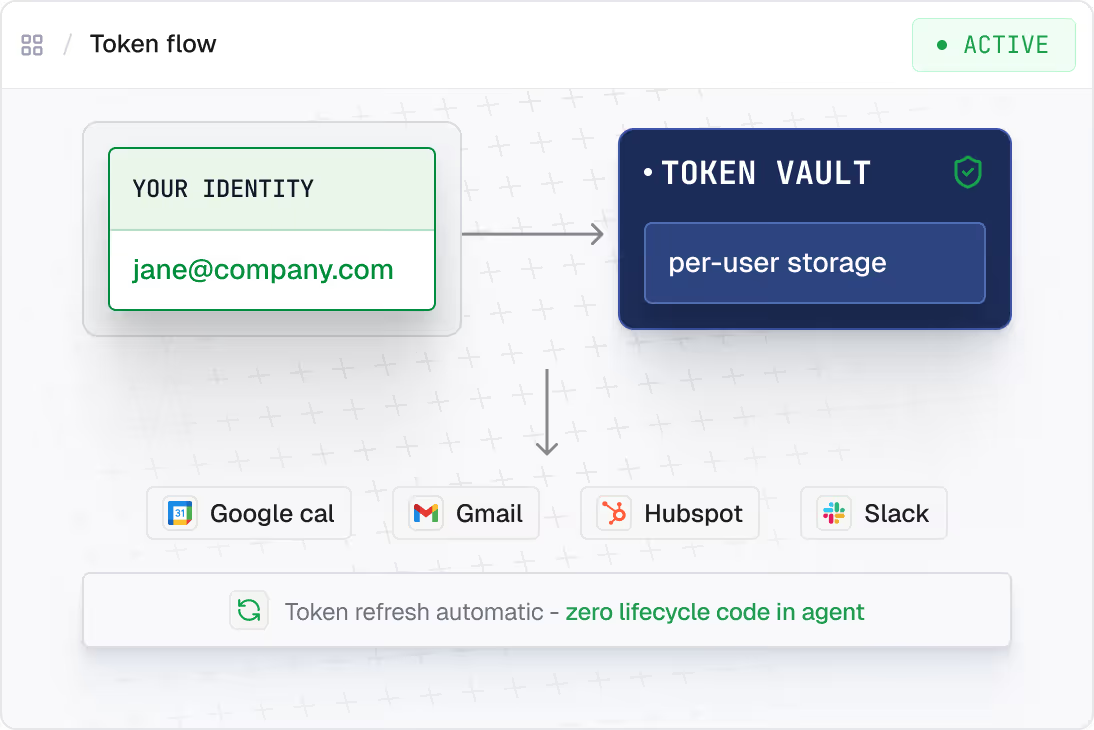
Delegated identity. Not service accounts.

Credentials never touch agent code or LLM context. The agent acts as the user, not as a shared bot.
Delegated OAuth - Agent reads your calendar, your inbox — scoped to the authorizing identity, not org-wide.
Credentials outside agent runtime  -  Tokens never touch agent code or LLM context. Both failure modes covered.
Token lifecycle automatic  -  Refresh, expiry, rotation across all connectors. One SDK call. Zero management code.
200+ prebuilt connectors  -  Google, Slack, HubSpot, GitHub, Jira, Notion, Salesforce — same auth pattern everywhere.
Try other Agent Templates

Prebuilt agents you can ship today

Each one runs on delegated identity, scoped per user.

ENGINEERING
DevOps assistant agent
Triage GitHub incidents, open Linear tickets, and notify the on-call channel in Slack with context already attached.
ENGINEERING
Engineering standup agent
Aggregate GitHub and GitLab activity, link to Jira, and post a daily standup digest to Slack. No async updates.
ENGINEERING
Auto-release notes agent
Group merged GitHub PRs by feature, fix, or chore and publish release notes per tag. No manual changelog grooming.
ENGINEERING
Slack workflow agent (LangGraph)
LangGraph agent that drives multi-step Slack workflows: triggers, approvals, and follow-up actions per user identity.
SUPPORT
Support triage agent
Read Zendesk tickets, fetch runbooks from Notion, and route to the right Slack channel with a drafted response.
OPS
Email-to-calendar scheduling agent
Parse scheduling intent from Gmail threads and create Google Calendar events with the right attendees and timezone.

Build your own
multi-connector agent

Add connectors. Change the LLM. Same delegated auth pattern.