Start for free
PRODUCTS
Agentkit
MCP Gateway for agents
Connectors & Tools
1,000+ apps, plus your own
Auth & credentials
Per-user tokens, handled
Virtual MCP servers
Scope tools by agent role
Triggers
Run agents on events
Logs
Every call, attributed
Enterprise
BYOK, VPC, and compliance
Also from scalekit
MCP Auth
OAuth 2.1 for MCP servers
Auth for saas
SSO, SCIM & RBAC for B2B
Agent gateway
Control team agent access
connector catalog
customers
PRICING
resources
COMPARE
Pick the right agent integrations platform
VS COMPOSIO
Credentials, scoping and enterprise controls
VS NANGO
Managed connectors vs code you maintain
VS PIPEDREAM
Priced per tool call, not compute time
Guides & research
Interactive Guide
Build or buy agent integrations?
Score 8 questions, get a build-or-buy decision framework
new report
Agents on the clock
See what a month of tool calls reveals
DOCS
Talk to us
Start for free
Virtual MCP Servers
Build a tool set for each agent.
From any app, behind one endpoint.
Pick the tools one agent role needs, from
any connector or your own API,
and
serve them as one endpoint.
Start for free
View docs
One endpoint.
Assembled from anything in your catalog.
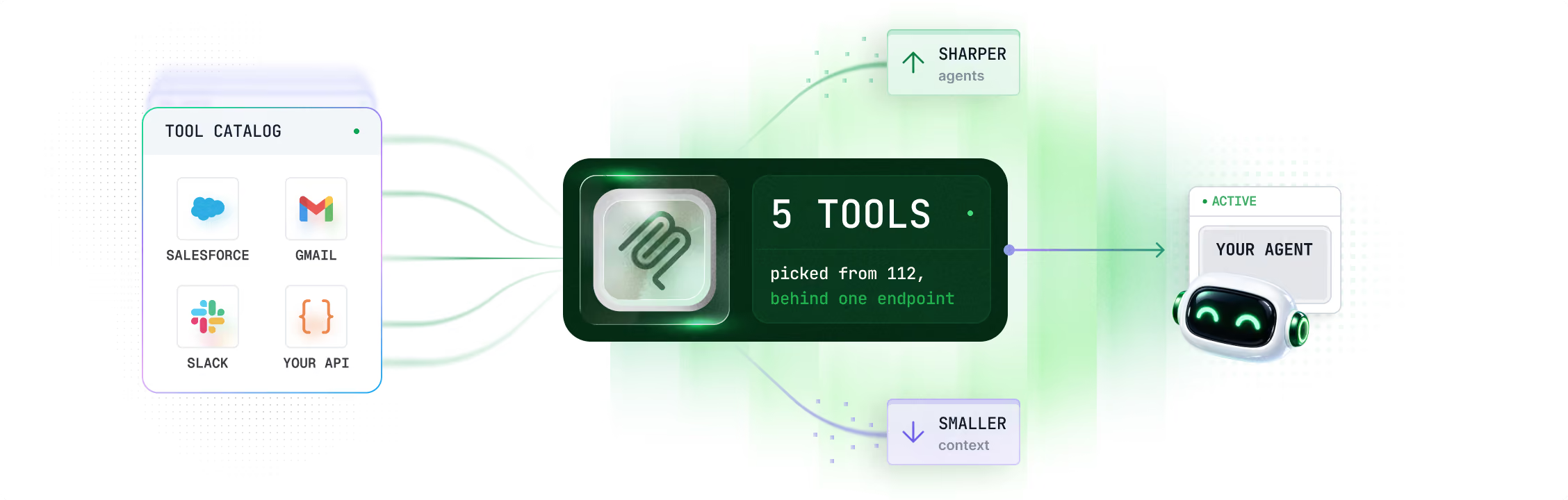
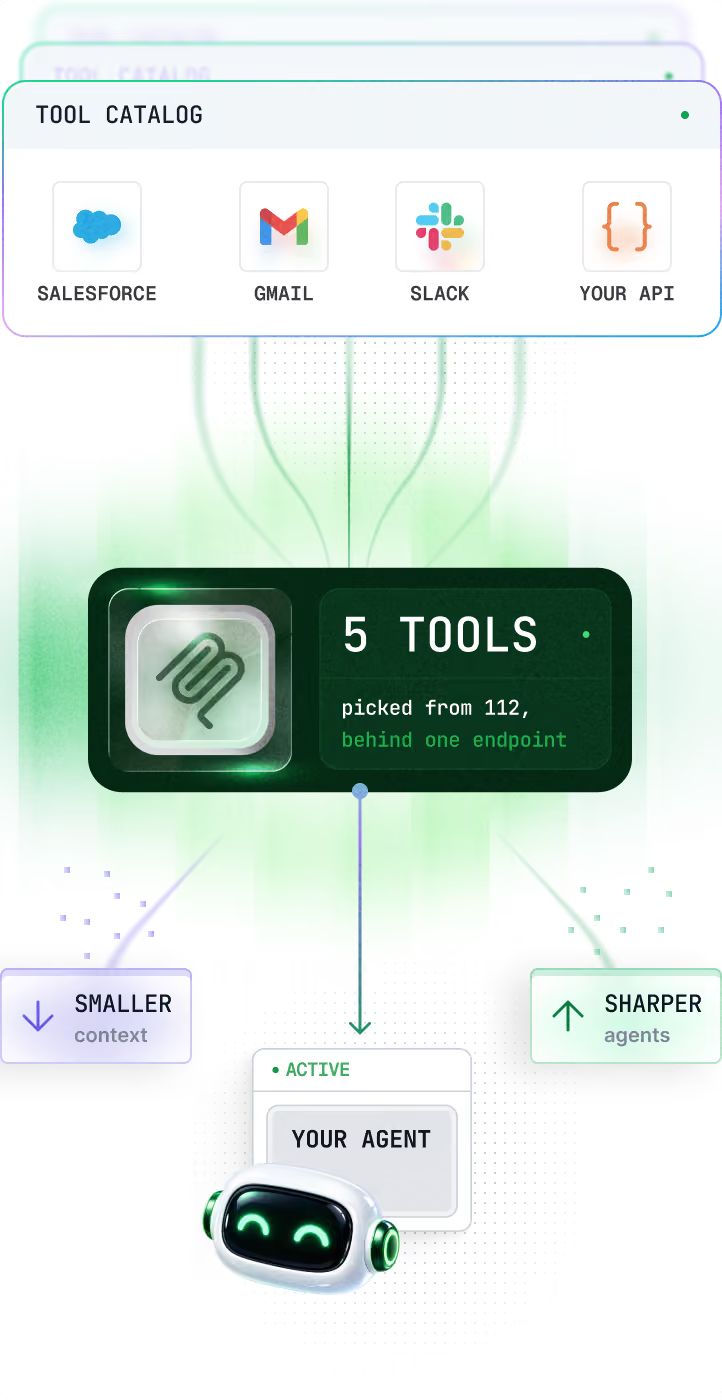
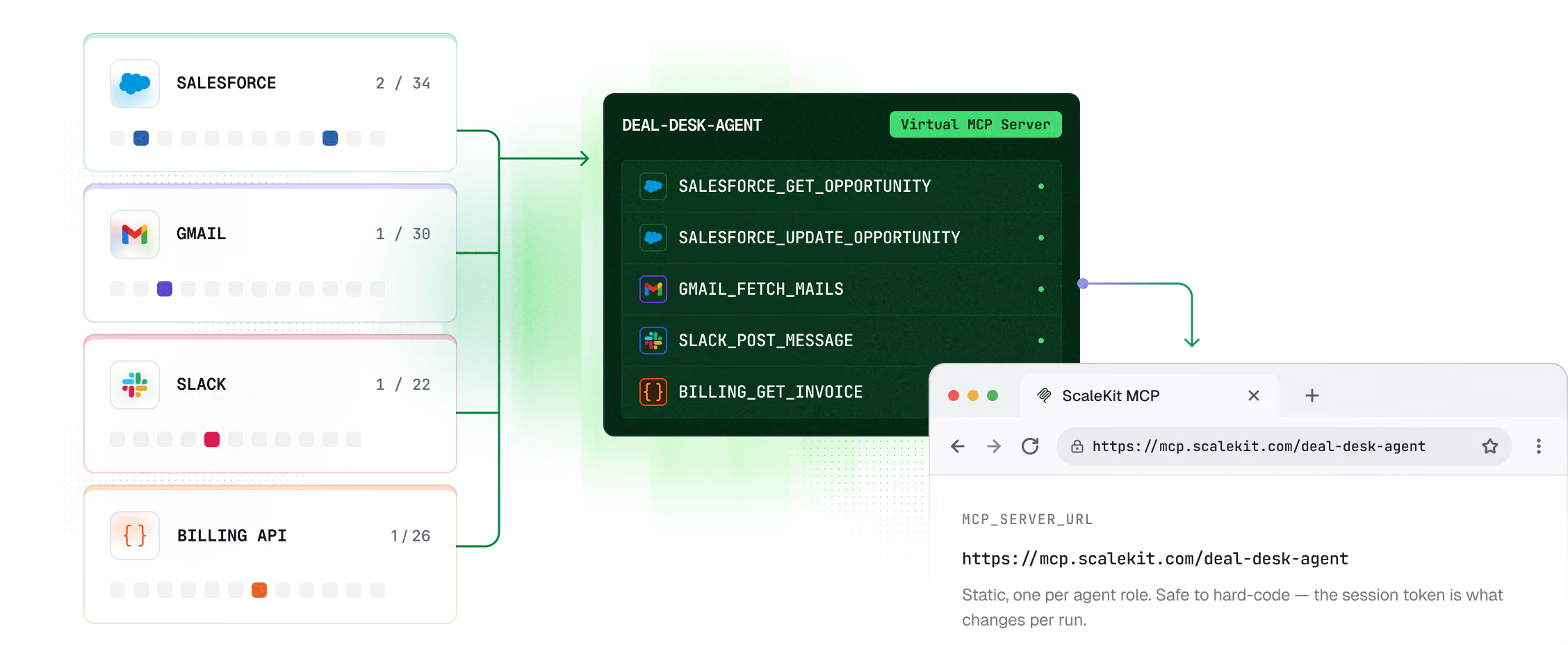
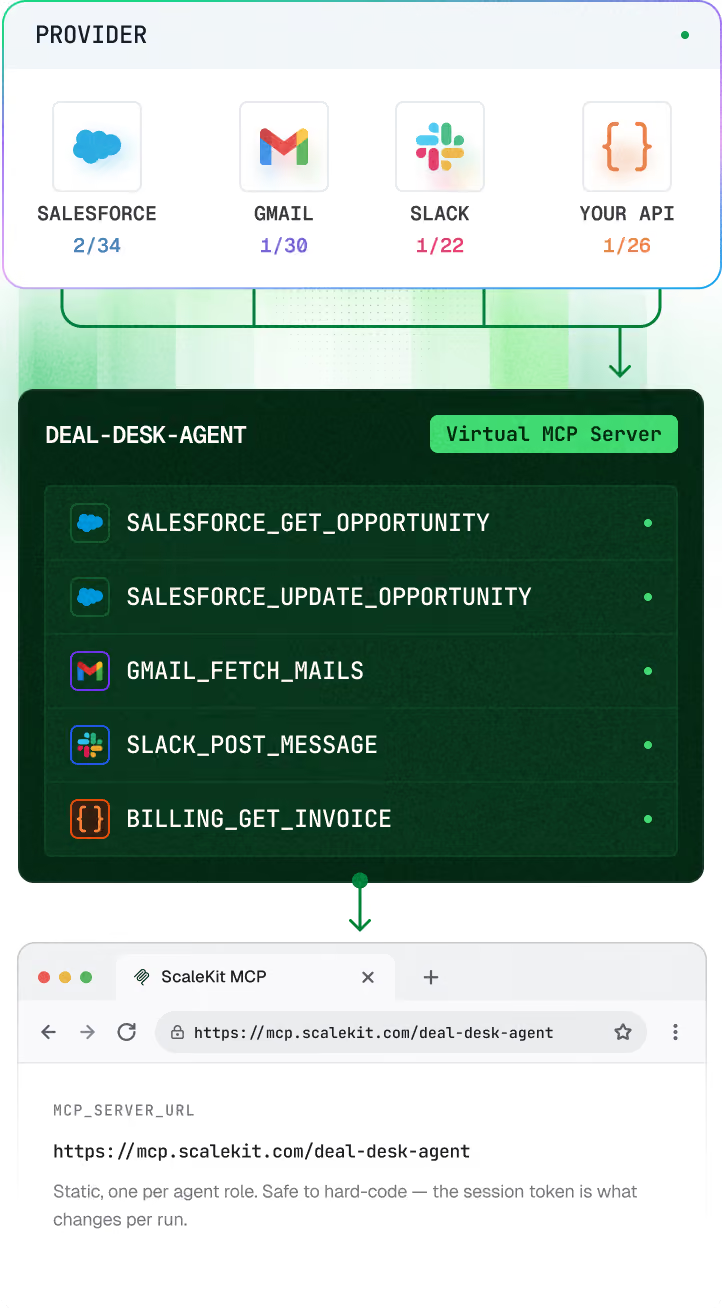
A deal desk agent needs an opportunity, an email thread, a Slack note and an invoice.
Give it those five tools, not all 112.
Every run, the model chooses from five.
Not from twenty thousand.
Give an agent only the tools its job needs,
and it picks the right one
the same way,
every run.
Clear context
More room for the task
Around 400 tokens of tool definitions instead of 8,000. The rest of the window goes to the work.
Just the right access
Access you set, not the prompt
A prompt asking the model not to delete can be ignored. A tool that isn't in the session can't be called.
Faster, more accurate
Fewer candidates, fewer wrong turns
Five candidates instead of forty means fewer wrong calls, fewer retries, and runs that finish sooner.
Set it up once.
Start a new session each run.
Define the tool set
once per agent role.
Each run then gets a session
for one user,
and
your agent always calls the same URL.
Once per role
Define the config
Name the connections and the tools you want from each. Omit the tool list on a connection to expose all of them.
actions.mcp
.create_config()
Per user, once
Check their accounts
See which of the required connections this user has authorized, and get an auth link for the ones they haven't.
list_mcp
_connected_accounts()
Per run
Create a session token
Scoped to that user's connected accounts and to this config. Fresh token before every run — never reuse one.
create
_session_token()
Per run
Point the agent at it
The static server URL, with the session token as a bearer credential. Your agent code doesn't change between users.
Authorization:
Bearer …
Token lifetime
Defaults to about an hour, set it yourself with expiry. Give it more room than the run needs.
No refresh endpoint
Tokens can't be extended in place. Mint a new one rather than holding a long-lived credential.
Stable identifier
An email, a UUID, whatever you use for a user — just keep it consistent across every call for that person.
Where a smaller tool set
matters most.
Every agent works better with fewer tools.
These four kinds of agents feel it most.
Agents that run on their own
No one reviews each step, so the agent can only use the tools you gave it. Anything else isn't there to call.
One agent, thousands of users
Set up the tool set once. Each user gets their own session with their own accounts, with no per-user setup.
Agents users are waiting on
Fewer tools means a smaller prompt and fewer wrong picks, so answers come back faster.
Apps serving many customers
Every customer runs the same agent code, and each one only reaches their own data. The gateway enforces it.
Build your first tool set.
It takes one call.
Free to start, no credit card.
Pick the tools, mint a session, and point your agent at the endpoint.
Start for free
Read the docs
We use cookies, so things load fast, we learn what to fix, and you can always reach us on chat
Okay, got it!