

Your agent needs to send appointment reminders, check delivery status, or triage a spike in failed verifications. You go looking for the Twilio MCP server, find one at mcp.twilio.com/docs, wire it into your agent, and discover that it will happily tell your agent exactly which endpoint sends an SMS but will not send one. That is not a bug. It is the design. Here is what each path actually gives a production agent, and which one your runtime should be built against.
Twilio ships three distinct surfaces that get called "the Twilio MCP server" or "the Twilio API" in conversation. They are not interchangeable, and two of them are not runtime surfaces at all. Naming them precisely is the first step in the decision.
Twilio's official MCP server is in Public Beta and hosted at mcp.twilio.com/docs. It indexes Twilio's public OpenAPI specs plus Twilio, SendGrid, and Segment documentation, covering over 1,800 endpoints across 30-plus products.
It exposes two tools in a search-then-retrieve pattern. twilio__search takes a natural-language query and returns ranked API operations with IDs. twilio__retrieve takes those IDs and returns full parameter and response schemas. The two-step design exists to keep context usage low by fetching detail only for operations the agent actually needs.
Three properties define it: no authentication, no installation, and read-only access. Twilio's documentation states the server "does not execute API calls on your behalf," and lists execute-ready, OAuth-authenticated MCP tools as a planned addition.
Separately, Twilio Labs publishes an alpha MCP server that does execute Twilio API calls. It runs locally over stdio, is configured by passing YOUR_ACCOUNT_SID/YOUR_API_KEY:YOUR_API_SECRET as a command-line argument, and requires --services or --tags filters because loading the full Twilio API surface blows past model context limits.
Twilio's own Help Center describes its status plainly: it is an alpha, experimental project, and it is not covered by Twilio Support.
The relevant reading is not "alpha means buggy." It is that a static credential pair passed as a process argument to a local server has no per-tenant isolation, no rotation, and no revocation path. That is a workstation tool, not a production dependency.
The Twilio REST API is served over HTTPS only, with https://api.twilio.com/2010-04-01 as the base URL for the classic resources: Messages, Calls, Recordings, Conferences, IncomingPhoneNumbers, and Accounts. Newer products live on their own subdomains and versions, such as messaging.twilio.com/v1 for Messaging Services and pricing.twilio.com/v1 for per-country SMS pricing.
Requests to the 2010-04-01 resources are sent as application/x-www-form-urlencoded and return JSON when you append the .json extension. Authentication is HTTP Basic; OAuth apps are available as an alternative.
The capability comparison for Twilio does not look like the Notion or Slack version of this table, where the MCP server covers most of what an agent needs and the API covers the rest. Here the hosted MCP server covers none of the runtime actions, because runtime actions are outside its scope by design.
The hosted MCP server's ceiling is not a missing feature list; it is a category boundary. It indexes public specifications. It has no notion of your account, your phone numbers, your message history, or your usage. There is nothing to scope, because there is nothing account-specific behind it.
That boundary is worth stating clearly because it changes what "MCP support" means when you are evaluating Twilio against connectors where MCP is a runtime path. A Notion or Slack MCP server acts on a workspace. The Twilio MCP server acts on a corpus.
Give the Twilio MCP server the credit it deserves. Coding agents building Twilio integrations routinely generate plausible-looking code against the wrong endpoint, skip prerequisite steps like Messaging Service configuration, or miss entire products that solve the problem more cleanly.
Feeding an agent exact operation IDs and full parameter schemas on demand fixes a real failure mode, particularly for newer products where model training data is thin. Pair it with Twilio Skills and your coding agent plans before it writes. That is genuine value at build time. It is not a runtime tool surface.
This is where the Twilio comparison diverges hardest from the rest of the series, because one of the two paths has no runtime auth model at all and the other has three of them.
The hosted MCP server requires no Twilio account and no API keys. Its connection options table lists exactly one row: hosted server, no auth. There is no OAuth consent flow, no token to store, no credential to rotate.
That sounds like a simplification, and at build time it is. It is also the reason the server cannot be your agent's execution path. No credential means no identity, and no identity means no action.
The REST API authenticates with HTTP Basic. You can use the Account SID as the username and the Auth Token as the password, or an API key SID as the username and the API key secret as the password. Twilio's documentation is direct: the Account SID and Auth Token pair is for local testing, and API keys are the recommended credential for production applications.
API keys come in three types. Main keys carry the same access as the Account SID and Auth Token. Standard keys reach every Twilio API except the Key and Account resources. Restricted keys, which scope access per resource, are documented against the Key resource v1 and are the closest thing Twilio offers to fine-grained scoping.
Twilio also supports OAuth 2.0 through OAuth apps created in the Console, with two grant types. Client Credentials (RFC 6749, Section 4.4) targets machine-to-machine access for backend services and scheduled jobs. Authorization Code (RFC 6749, Section 4.1) targets applications acting on behalf of a user who explicitly approves access.
Access tokens are short-lived and scoped, which is a real improvement over a permanent Auth Token. But note the constraint in Twilio's own FAQs: account-level OAuth apps work only for the account they were created in, not for its subaccounts, so a subaccount that needs an account-level OAuth app needs its own. To understand why this matters for AI agents in production, the credential-per-account model compounds quickly at scale.
Twilio's recommended architecture for anyone sending on behalf of customers is subaccounts. A parent account holds administrative settings; each customer gets a subaccount with its own Account SID and Auth Token, its own phone numbers, its own usage records, and its own compliance blast radius, all billed to the parent. A main account supports up to 1,000 subaccounts by default.
That model is architecturally correct and it is also the credential problem in concrete form. Forty customers means forty subaccount credential sets, or forty API key pairs, or forty OAuth apps. Twilio issues them. Twilio does not store, rotate, isolate, or revoke them on your behalf.
Neither path removes the operational surface a Twilio agent generates. The hosted MCP server removes nothing at runtime because it participates in nothing at runtime. The API path leaves you owning the full stack.
Twilio's REST API enforces concurrency limits rather than a single published requests-per-second ceiling. Exceed them and you get HTTP 429 with error code 20429; those requests are never processed and are always safe to retry. Twilio returns a Twilio-Concurrent-Requests header on responses so you can watch your own usage, and subaccount request counts do not roll up to the primary account.
This matters more for agents than for traditional integrations. An agent triaging a delivery failure will list messages, fetch a specific message, list media, then pull today's usage records, all in one reasoning turn. Deterministic integrations issue one call per action; agents issue four or five. Implement exponential backoff with jitter from day one.
If your agent needs to react rather than poll, that lives entirely on the API side. Status callbacks fire per message or call, and Event Streams consolidates events across Messaging, Voice, TaskRouter, and other products into a single pipeline with at-least-once delivery and retries for up to four hours.
Event Streams caps each account at 100 Sink resources and 100 Subscription resources. In a subaccount-per-tenant architecture that limit applies per account, which is usually fine, but it is worth checking before you design a sink-per-customer pattern.
The hosted MCP server's index changes whenever Twilio publishes new specs, and search returns the latest API version by default unless you pass filter.version. Programmable Messaging, for example, has both a v2010 and a v1 surface, and search returns v1 unless you ask otherwise.
On the API path you pin the version in the URL path itself. 2010-04-01 has been stable for over a decade. For a deterministic pipeline where an unexpected parameter change is an incident, that stability is the point.
The lists below are Twilio-specific. Generic MCP advice does not survive contact with a server that cannot execute anything.
Use the Twilio MCP server when:
Use the Twilio REST API when:
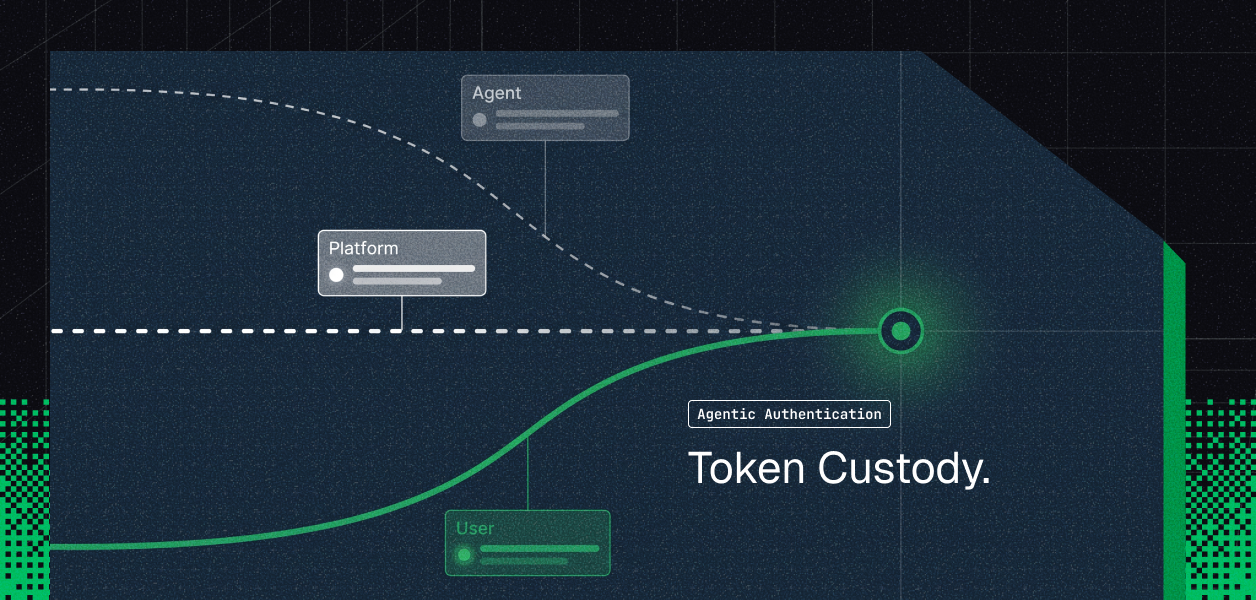
For most connectors in this series, both paths hand you a token per user and the argument is that neither manages its lifecycle. Twilio inverts the framing: the MCP path hands you nothing, so 100 percent of the credential problem sits on the API path. The problem does not get smaller. It gets concentrated.
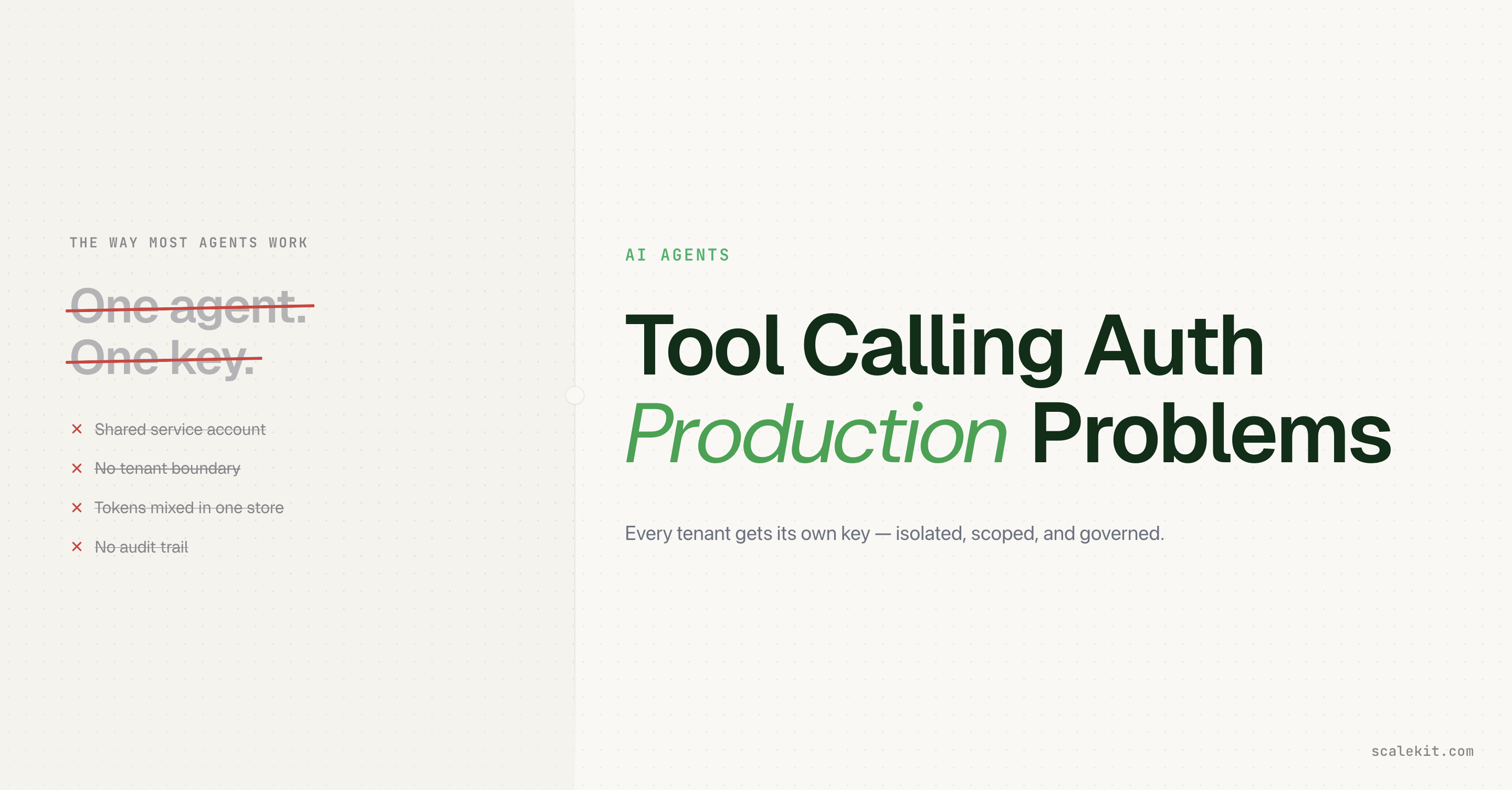
A single Account SID and Auth Token in an environment variable is the obvious first implementation, and it works in a demo. In a multi-tenant agent it fails in three specific ways.
Attribution collapses, because every message and call appears under one account with no link back to the tenant that triggered it. Blast radius expands, because one compromised token reaches every customer's numbers, message bodies, and recordings. And Twilio's own compliance guidance stops applying, because subaccount isolation exists precisely so that non-compliant traffic from one customer does not suspend the rest.
Twilio issues credentials. It does not encrypt them at rest for you, isolate them per tenant, rotate them, detect that a customer rotated their Auth Token out from under your agent, or revoke them when a customer churns. Those are your systems to build.
That is true whether the credential is an Auth Token, an API key secret, or an OAuth client secret. The token type differs. The infrastructure required does not. For a deeper look at who holds the token across agent tool-calling patterns, the structural challenge is the same regardless of which Twilio surface you choose. Scalekit's Twilio connector holds the credential set per connected account, injects it at call time, and keeps it out of agent runtime and LLM context, so the MCP versus API decision does not change your auth architecture.
Scalekit's Twilio connector is a direct API connector using basic auth, and it currently ships 31 prebuilt tools spanning messages, calls, conferences, conversations, recordings, phone numbers, Verify services, and usage records. As of this writing there is no separate Twilio MCP connector in the catalog, which correctly reflects the fact that Twilio's MCP server has nothing to execute.
Create the connection once per environment in the Scalekit dashboard under AgentKit then Connections then Create Connection, search for Twilio, and supply the Account SID and Auth Token. Note the connection name that Scalekit assigns; that exact string is what you pass as connection_name in code.
Connection names are workspace-specific and differ across environments, so never hard-code them. Put the value in an environment variable such as TWILIO_CONNECTION_NAME. Mismatched connection names are the single most common integration error.
Each tenant gets a connected account keyed by an identifier you choose. For basic-auth connectors like Twilio, Scalekit's hosted page presents a credential form rather than an OAuth consent screen, so the tenant supplies their own Account SID and Auth Token, or the SID and token for the subaccount you provisioned for them.
That is what makes subaccount-per-tenant work end to end: the tenant's credentials land in the vault against their identifier, and every subsequent tool call for that identifier resolves to that credential set.
Before the agent runs, retrieve the tools this tenant's connected account is authorized to call. This is not a catalog lookup. The agent is not handed every Twilio tool Scalekit ships; it receives the surface that this specific connected account can execute, which is what makes the same agent safe to run for tenant A and tenant B.
Scalekit returns native LangChain StructuredTool objects, so there is no schema reshaping between the connector and the model. Bind them and run the loop. For a broader look at how LangChain tool calling works and where it stops, the same patterns apply when Scalekit provides the underlying tool surface.
When you already know which action you want, skip the model and call execute_tool. The connected account is selected by the identifier plus connection_name pair.
The Node SDK follows the same retrieve-then-execute shape. Note the toolNames filter, which narrows the surface further than the connector default before anything reaches the model.
The current Twilio tool list is read, inspect, and lifecycle oriented: list, get, delete, plus twilio_verify_service_create. Outbound sends are not in the prebuilt set as of this writing, so check list_scoped_tools against the connector tool list before assuming an action exists.
For anything not covered, define a custom tool and proxy the call through the same connected account with actions.request. Scalekit resolves the base URL and injects the tenant's credentials; your agent still never sees them.
One Twilio-specific detail to confirm when you wire this up: the 2010-04-01 resources expect application/x-www-form-urlencoded parameters with capitalised names such as To, From, and Body, not a JSON body. Validate the content type your proxy sends before you ship.
Tool bloat is a general problem. On Twilio it is a specific one, because the underlying API is one of the largest in the connector catalog and the temptation to expose all of it is strongest here.
Twilio's own MCP server indexes more than 1,800 endpoints across 30-plus products. The Twilio Labs alpha server requires --services or --tags filters for exactly this reason: loading the full surface exceeds model context limits.
That constraint does not disappear when you switch to direct API calls. It moves into your tool definitions. Hand a model 40 tools at roughly 200 tokens each and you burn 8,000 tokens before the agent does any work, and the model is selecting from a decision space it was never designed to handle at that scale. Wrong tool selection and hallucinated parameters follow.
list_scoped_tools returns only what the current connected account is authorized to call. Scoping from 40 tools to 5 or 10 cuts token overhead by roughly 80 percent and materially improves selection accuracy. A better model operating on a bloated surface still underperforms a correctly scoped one. Model upgrades help. They are not the lever. This is why tool calling auth patterns in production emphasize surface scoping as a first-class concern, not an afterthought.
For multi-tool and multi-tenant agents, Virtual MCP Servers make that scoping declarative. You define once, per agent role, which connections and which tools are exposed, and you get a static mcp_server_url. Before each run you mint a short-lived session token bound to a specific user. The endpoint is static; the identity is not.
A delivery-triage agent needs three Twilio tools, not thirty-one. A reminder agent needs a send path and a status read, plus a calendar connection. Each gets its own server definition, and neither can reach the other's surface.
Twilio agents spend real money and send real messages to real phone numbers. When something goes wrong, "which tenant's agent sent that message, under whose credentials, and why" is a question you will be asked, and standard application logs do not answer it. Agent tool observability is not optional at production scale — it is what separates an agent you can operate from one you can only demo.
Because every tool call resolves through a connected account keyed by your identifier, Scalekit records which tenant authorized the credential, which connection was used, which tool ran, and what came back. That gives you an audit trail tied to an identity rather than to a shared service account, and it is exportable to your SIEM.
The contrast is concrete. With one shared Account SID in an environment variable, your Twilio console shows a message log and your application shows a request log, and correlating them across forty tenants is a manual exercise. With per-tenant connected accounts, the correlation is the record.
Connected accounts carry an explicit state: PENDING, ACTIVE, EXPIRED, REVOKED, or ERROR. The connected_account.status_updated webhook fires on every transition and includes both the new and previous status, so you can filter for the transition that matters and prompt the tenant to reconnect.
This is the difference between finding out that a customer rotated their Auth Token when your nightly reminder run fails silently, and finding out when the status changes. Twilio will not tell you. The connected account will.
The framing that holds for Notion, GitHub, and Slack does not transfer here, so state the Twilio version explicitly rather than reaching for the series template.
Is this a build-time question or a runtime question? If your coding agent needs to understand Twilio's API surface while writing your integration, point it at mcp.twilio.com/docs and give it Twilio Skills alongside. If your product's agent needs to send, call, verify, provision, or read, build against the REST API, because that is the only path that executes anything.
Twilio has said execute-ready, OAuth-authenticated MCP tools are planned. When they ship, the capability table changes and the credential table does not. You will still have one credential set per customer account or subaccount, still needing storage, isolation, rotation, and revocation. For teams thinking through whether to build that layer themselves, understanding the hidden cost of building OAuth internally for AI agents is a useful calibration. That layer is worth solving once, independent of which surface Twilio ships next.
Building on Twilio surfaces a specific set of questions: subaccount versus API key isolation, backoff under 429s, keeping message attribution intact across tenants. Those are worth asking out loud.
Join the Scalekit Slack community to compare notes with other agent builders, or talk to an engineer if you want help on a specific architecture right now.
Browse the Twilio connector and the Twilio connector docs.