
Oh, the seductive simplicity of "We'll Build It." Very tempting, right? It starts innocuously – as most expensive decisions do.
Your AI agent needs to read a user's Slack channels and post summaries. You open the Slack OAuth docs, implement the Authorization Code flow in an afternoon, store the access token in your database, and ship. Your demo works flawlessly. Your team is proud. Your CTO says "good call on building that internally – we own it now."
Six months later, the same team is debugging a silent token expiry race condition affecting 12 enterprise tenants. A senior engineer is rewriting the refresh scheduler for the third time. Your SOC 2 auditor is asking why there's no per-tenant token isolation. And a $400K enterprise deal just got stalled because the security questionnaire asked about your revocation controls and OAuth scope governance – questions your homegrown system wasn't designed to answer.
This is more or less the story of virtually every AI SaaS company that chooses to build OAuth internally for AI agents rather than abstracting it behind purpose-built infrastructure.
The problem with OAuth for AI agents that teams don't foresee is that it's a distributed systems problem, a cryptographic key management problem, a compliance problem, and a multi-tenant isolation problem – all at once, all stacked on top of each other, and all evolving as your provider integrations, your MCP server connections, and your enterprise customer requirements evolve.
This Scalekit insight is a precise accounting of what that actually costs: in engineering hours, in security posture, in deal velocity, and in the long-run financial model that founders and VPs of engineering almost never see until it's too late.
Before we can cost-model the build path, we need to be exact about what "OAuth for AI agents" encompasses. This is not the same as "adding a login button."
Traditional web apps typically use one OAuth flow. AI SaaS systems serving autonomous agents need at minimum three – each with distinct implementation requirements, token lifecycle properties, and security controls.
SaaS engineering surfers venturing into AI waters, this is for you.
The critical distinction between traditional OAuth and OAuth for AI agents is that agents operate beyond the user session. A standard web app OAuth token lives as long as the browser tab. An AI agent's delegated authority must persist across:
This means what looks like a "simple OAuth redirect" in your demo is actually long-lived credential infrastructure in production. And long-lived credential infrastructure requires token storage architecture, refresh orchestration, revocation handling, tenant isolation, audit logging, and compliance controls – none of which your initial implementation includes.
Here is what your team actually has to build when they commit to "we'll do OAuth internally" for AI agent workflows.
Week 1: Basic Flow Implementation
Estimated: 1 senior engineer. 80 hours.
Did you just splutter "Why an entire week?" Well, here's a basic callback handler:
Notice two critical mistakes embedded in what looks like working code: storing tokens in plaintext and potentially logging them on error. Both will come back to haunt you in SOC 2 review.
Week 2: Token Storage Schema
Now you realize you need to model the token properly:
This schema looks reasonable. But it assumes you already have a KMS (AWS KMS, Google Cloud KMS, HashiCorp Vault) with per-tenant key isolation. Setting that up properly is another sprint in itself.
Estimated: 1 senior engineer. 80 hours.
Total (Phase 1): 2 engineers. 160 hours.
This is where most teams hit their first serious wall. Access tokens from Slack expire every hour. Google tokens expire every hour. GitHub tokens vary. But refresh tokens also have their own lifecycle rules that vary per provider and are often underdocumented.
The naive approach (that will break in production):
The production approach (what you actually have to build):
This is the minimum viable refresh handler for production multi-tenant agents. It requires: Redis (or equivalent), per-tenant KMS encryption/decryption, an admin notification system, a requires_reauth state machine, and careful distributed lock TTL tuning.
Estimated Phase 2: 2 engineers × 1 week = 160 hours
You now have to audit every single path where a token is read, refreshed, or used to ensure that tenant context is never assumed – only verified.
For each integration: audit the token lookup. Audit the cache layer (Redis keys must include tenantId). Audit the background job scheduler (jobs must carry tenant context). Audit the webhook handler (provider webhooks include enough context to derive tenant). Audit the error logs (scrub tokens from stack traces).
Estimated Phase 3: 1 engineer × 1 week = 80 hours
Scope governance means building internal tooling to:
Revocation means handling:
Offboarding means a user leaving an organization must cleanly terminate all their delegated agent access without affecting other users in the same tenant.
Estimated Phase 4: 1–2 engineers × 1–2 weeks = 80–160 hours
Enterprise customers and compliance audits will ask:
Building audit-grade logs for OAuth lifecycle events – authorization grants, token refreshes, scope validations, revocations – is a non-trivial operational engineering problem.
Estimated Phase 5: 1 engineer × 2 weeks = 160 hours
At a fully-loaded senior engineer cost of $100–150/hour (including benefits, overhead, and opportunity cost), this is a $90K–$110K investment in infrastructure that generates zero direct revenue and will need to be maintained indefinitely (as it will accrue technical debt.)
And this estimate assumes everything goes right, the first time. Well, if you've been in engineering for a while, you know "It won't."
The hours above are for the normal path. The real cost of build vs buy OAuth AI lives in the edge cases – the scenarios that don't exist in demos, that appear in production at 3 AM, and that your initial architecture wasn't designed to handle.
Every major provider has different rules about refresh token expiry:
Your background refresh scheduler runs every night. But what about an enterprise tenant that only uses the feature quarterly? That refresh token quietly expired two months ago. The next time the agent runs, it silently fails – and your scheduler marks the job as "completed" because the error handling doesn't distinguish refresh_failed_token_revoked from api_temporarily_unavailable.
Building proper detection and re-consent workflows for every provider-specific expiry pattern is typically a two-week engineering project that no one budgets for upfront.
Imagine you have 1,000 enterprise tenants, each with a 1-hour token expiry from Slack. Your background scheduler runs every hour. If your scheduler doesn't implement per-token distributed locking, and multiple worker processes start simultaneously, you can end up with:
Yes, a theoretical scenario, but very possible in production, and may have been a nightmare to multiple well-funded AI SaaS teams. Why else do you think that even the giants like OpenAI and Anthropic outsource Auth?
Anyway, the fix to concurrent refresh race conditions requires distributed locking with careful TTL management and retry semantics – adding another layer of infrastructure dependency (Redis, Memcached, or a database-backed advisory lock).
When a Slack workspace admin revokes your app's access and then re-authorizes it the same day, your callback handler may hit Slack's rate limits on the token exchange endpoint during a high-traffic period. Your retry logic (if you have any) needs to implement exponential backoff – but the OAuth flow has a time-bounded code exchange window (typically 10 minutes). If your retry loop expires the code, the user sees a generic error and has to start over.
This is one of the most common sources of user-reported OAuth failures that are genuinely hard to debug.
Enterprise customers often require your app to be deployed in their VPC or on custom subdomains. Slack, GitHub, and Google require pre-registered redirect URIs. When a customer wants their own subdomain (ai-agent.enterprise-corp.com), you need to register new redirect URIs for each OAuth app per environment. If your OAuth app registration is centralized but your redirect URIs aren't parameterized correctly, you'll start seeing redirect_uri_mismatch errors that are extremely difficult to trace without good audit logging.
Your security team mandates quarterly KMS key rotation. Now you need to decrypt every token in your database (with the old key) and re-encrypt it (with the new key) – atomically, without downtime, across potentially millions of rows. If this migration fails partway through, you have a subset of tokens that can no longer be decrypted, and a subset that can. Your background jobs will start failing silently for affected tenants. Recovery requires manual intervention and potentially re-authorization flows for every affected user.
If your AI agents connect to external services via MCP (Model Context Protocol) servers, the OAuth complexity compounds. Each MCP server requires its own OAuth 2.0 authorization flow, often on top of the provider's existing OAuth. As noted in the MCP spec, you must also implement:
The practical consequence: you're not building one OAuth client. You're building a general-purpose OAuth infrastructure layer that can discover, register with, and maintain long-lived delegated access to arbitrary OAuth-protected MCP servers – with per-tenant token isolation across all of them.
This is a qualitatively different engineering problem from "implementing a Slack OAuth flow."
The MCP authentication specification has already gone through multiple major revisions in 2025 alone (March → June → November). Each revision brought new capabilities and new implementation requirements. Teams that built against early spec versions found themselves doing significant refactoring work to maintain compatibility. As one industry observer put it: "Engineering teams that built against the March spec found themselves refactoring for June."
When you build OAuth infrastructure internally, you own the obligation to track spec evolution and maintain compatibility. When you buy, that tracking becomes someone else's full-time job.
Every honest discussion of build vs buy OAuth AI must confront this: OAuth infrastructure is not a project. It's a permanent operational responsibility.
Major OAuth providers change their token endpoint behavior, refresh token policies, scope definitions, and webhook formats – with varying levels of advance notice:
Every one of these changes requires your team to: detect the change (often from a provider changelog email or a burst of production errors), understand the impact, implement the fix, test across tenants, and deploy – usually on a tight timeline to avoid service disruption.
OAuth security vulnerabilities are discovered and disclosed regularly. The IETF published RFC 9700 in January 2025 as a major update to OAuth 2.0 security best practices, adding new requirements around redirect URI validation, token binding, and PKCE enforcement. Additional updates to the Security Best Current Practice were published later in 2025 addressing new threats.
When you own your OAuth infrastructure, you must track these publications, assess their impact on your implementation, and ship fixes – often under time pressure when the vulnerability is actively being exploited in the wild.
Each provider you integrate behaves differently in ways that are not well-documented:
Your team will discover every one of these quirks through production incidents. Each discovery costs debugging time, post-mortem time, and fix-and-deploy time.
SOC 2, ISO 27001, HIPAA, and GDPR all have ongoing audit requirements that touch your OAuth implementation:
Each compliance renewal cycle will surface new questions about your OAuth implementation, requiring engineering time to answer, remediate, and document.
Here's a number that doesn't show up in most build vs buy analyses: 41% of businesses without a continuous compliance program experience significant slowdowns in their enterprise sales cycle.
Your OAuth implementation is directly in the critical path of your SOC 2 audit. And every enterprise security questionnaire will probe it explicitly.
On token storage:
On token lifecycle:
On tenant isolation:
On audit trails:
If you built OAuth in-house, and you didn't build it with SOC 2 in mind from day one, you will be answering "we're working on that" to several of these questions. And "we're working on that" extends your deal cycle by weeks to months.
Several OAuth providers (notably Google and Meta) require app re-verification when you modify your requested scopes or expand the categories of data your application accesses. This verification process:
If your scope model evolves because a customer asks for a new integration feature, you may need to halt that feature until re-verification completes. This is a business risk that is eliminated when your OAuth infrastructure abstracts scope management behind versioned, pre-approved bundles.
Enterprise customers in the EU, Germany, Japan, and Australia often require that OAuth tokens and associated metadata be stored in specific geographic regions. If your token storage infrastructure is centralized, you may need to build geo-partitioned storage specifically for OAuth tokens – a significant infrastructure investment that has nothing to do with your core product.
Modern enterprise sales cycles include security questionnaires – typically 200–400 questions administered through platforms like OneTrust, Whistic, or SecurityScorecard. The authentication and authorization section routinely includes questions that map directly to OAuth implementation quality:
API key-based or poorly architected OAuth systems fail every one of these questions. And unlike a product roadmap question ("will you have SSO by Q3?"), security architecture questions rarely get a "promise to build" pass.
Scalekit's Agent Auth is built explicitly to answer these enterprise security questions from day one. The connection and connected account model means:
When a security reviewer asks "can you demonstrate per-user revocation?", the answer is a one-click operation in the Scalekit dashboard – not a two-sprint engineering project.
Let's be honest about 3-year cost contributors for the build path vs. the buy path for a mid-stage AI SaaS company with 50–500 enterprise tenants and 5–10 provider integrations.
And this doesn't include:
Scalekit starts free and scales with your usage. Even at a generous estimate of $2,000–5,000/month at 100+ enterprise tenants, the three-year buy cost is:
The financial case for buying is straightforward. But the real argument isn't even the cost savings – it's the engineering focus savings. Every hour your senior engineers spend on OAuth infrastructure is an hour not spent on your core AI product.
This is an honest analysis, so we have to answer this: are there legitimate reasons to build OAuth internally for AI agents? Yes. But they are narrow.
If you are building an identity platform – if OAuth infrastructure is the product you're selling – then building is not just justified, it's required. Your investment in deep OAuth expertise, protocol-level compliance, and infrastructure resilience is what customers are buying.
This applies to companies like Okta, AWS Cognito, and yes, Scalekit itself. These products/companies exist specifically because OAuth infrastructure is sufficiently complex to justify dedicated engineering investment.
If you are an AI SaaS company – if your product creates value through AI-powered workflows, agent automation, or intelligent integrations – OAuth is infrastructure, not product. The distinction matters enormously.
Regulated industries (defense, banking, healthcare in some jurisdictions) may have requirements that disqualify third-party OAuth infrastructure:
In these cases, building (or using open-source self-hosted options like Keycloak) is the only viable path. But even here, the question is "build the business logic" vs. "build the compliance-validated infrastructure from scratch." Most regulated deployments use a certified authorization server framework rather than implementing RFC 6749 from the ground up.
Some enterprise integrations require proprietary extensions to standard OAuth flows – custom assertion grant types, non-standard token formats, or provider-specific authentication extensions that no commercial platform supports. If your core integration depth depends on these extensions, building the specific layer that handles them makes sense.
The key question is: Are you building a custom layer on top of standard OAuth infrastructure, or are you rebuilding the standard infrastructure from scratch? The former is reasonable. The latter is almost never justified.
The fundamental argument for infrastructure abstraction isn't cost. It's complexity boundary management.
Every system has a finite capacity for complexity. The teams that build the most successful AI SaaS products aren't the ones that handle the most complexity – they're the ones that most aggressively push non-core complexity outside their boundary.
OAuth lifecycle management for multi-tenant AI agents is not core complexity for an AI SaaS product. It is infrastructure complexity that your product depends on, the same way it depends on PostgreSQL, Redis, or your cloud provider's object storage. You don't build a database engine. You don't build a CDN. You configure and operate them.

With Scalekit's Agent Auth, the OAuth lifecycle collapses to three abstractions:
Connection: Defines the provider integration boundary (Slack, GitHub, Google Drive, Salesforce). Configure it once – client credentials, allowed scope bundle, redirect configuration.
Connected Account: Represents an authenticated identity under a connection. Created when a user completes the OAuth consent flow. Carries an internal identifier that your agent uses instead of raw tokens.
Action Execution: Your agent calls execute_tool() with a connected account identifier. Scalekit resolves the identifier to the encrypted token, validates expiry, refreshes if needed, calls the provider API, and returns structured output.
Your agent never sees a token. Never manages expiry. Never implements refresh. Never handles tenant isolation. Never deals with key rotation. All of that is inside the abstraction layer.
Compare this to the production implementation your team would build:
This is the same operation. But the homegrown version owns the distributed lock, the KMS decryption, the refresh logic, the error classification, the reauth state machine, and the Slack-specific error handling. Each of those is a failure mode. Each is a maintenance obligation. Each adds latency. And there are 8 more provider integrations with their own quirks.
For teams already operating in production, Scalekit's connection and connected account model maps cleanly onto existing architecture patterns:
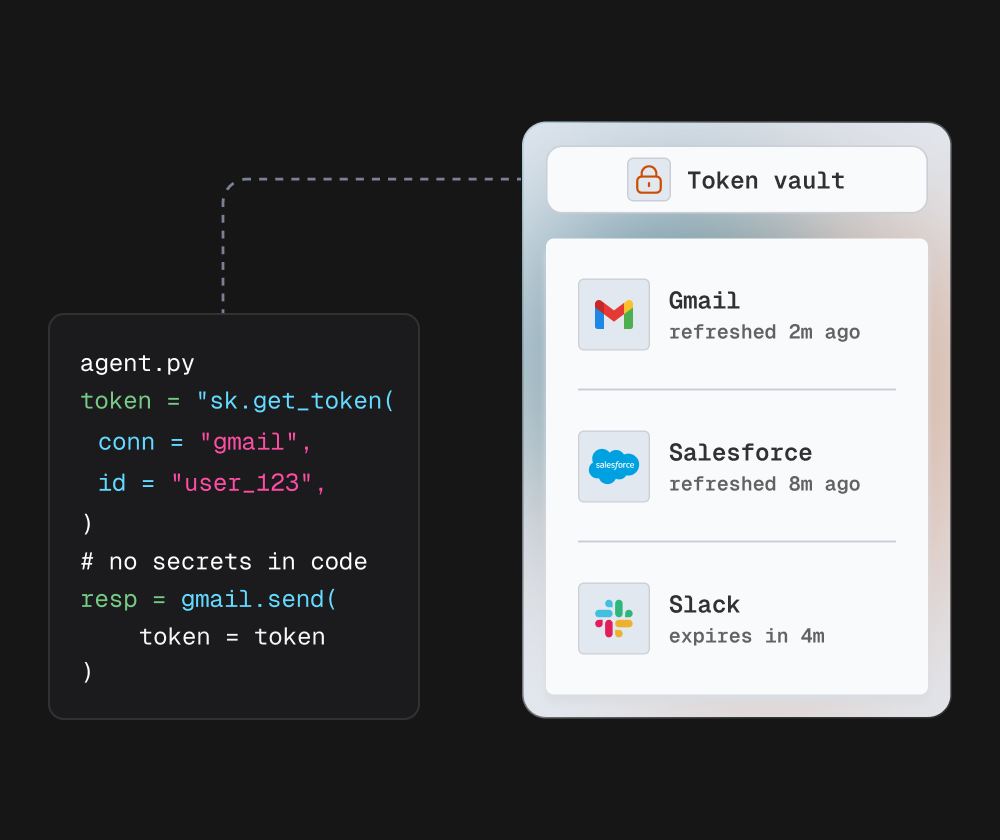
Your agent runtime knows nothing about tokens. Scalekit handles everything between "I need to call Slack as user_123" and "here is the result."
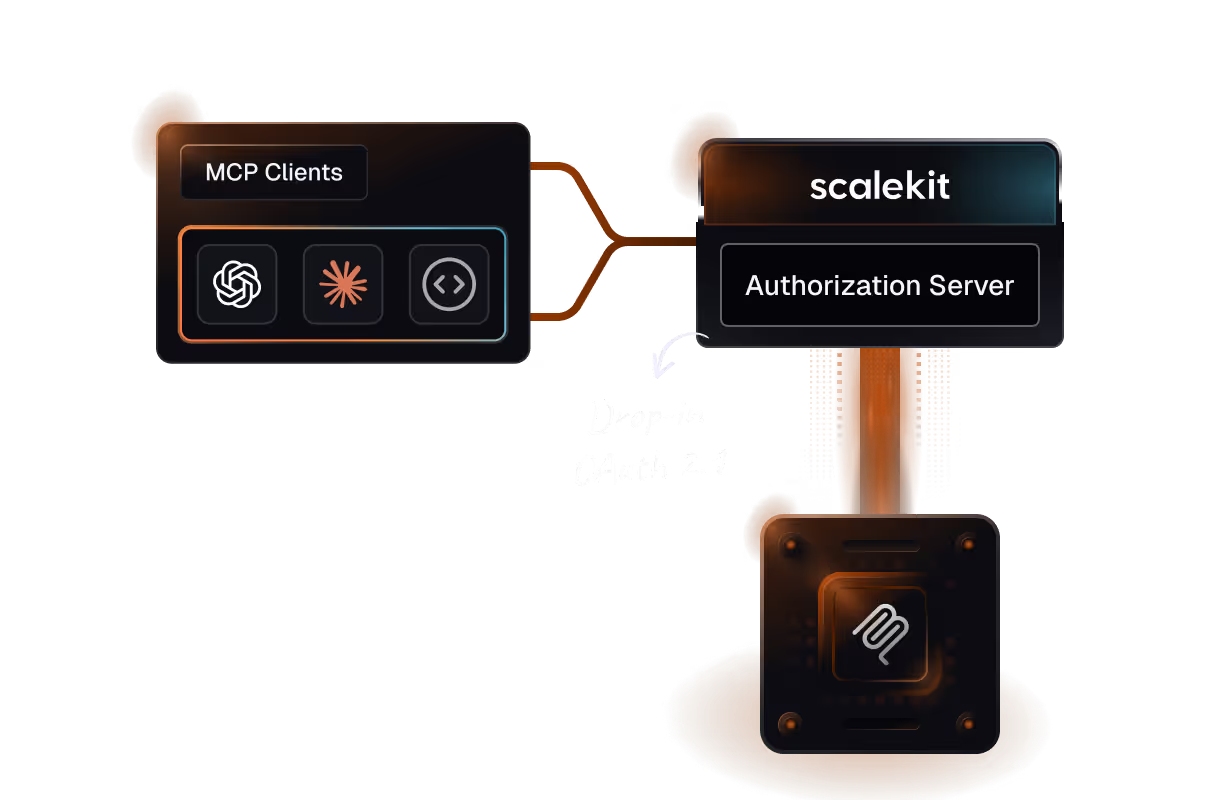
If your agents are or will be connecting through MCP servers, the abstraction argument becomes even stronger. Scalekit's MCP Auth provides:
The alternative – building MCP auth compliance from scratch – means implementing multiple IETF RFCs, tracking an evolving specification, and building the discovery, registration, and token exchange flows that make arbitrary MCP server connections work securely.
Scalekit's product is already SOC 2 Type II compliant and tracking the MCP auth spec in real time. When the spec evolves (and it will), Scalekit updates the platform. Your agents keep working.
For technical founders and engineering leaders making this decision today, here is an actionable evaluation framework:
Q1: What is your engineering team's OAuth/identity expertise depth?
Be honest. Most generalist engineering teams have written an OAuth flow but haven't implemented production-grade token storage with per-tenant KMS key isolation, distributed refresh locking, or provider-specific quirk handling at scale. If you don't have 2+ engineers who can enumerate the edge cases in section 4 from memory, you're going to discover them in production.
Q2: What is the opportunity cost of diverting engineering capacity to auth infrastructure?
Calculate the number of product features, AI capability improvements, or customer integrations that 6–12 months of auth infrastructure work would displace. For most AI SaaS teams in growth stages, that opportunity cost is an existential question.
Q3: When is your first enterprise customer security review?
If it's in the next 6 months, you don't have time to build. Enterprise security reviews take 2–4 weeks and require production-quality OAuth infrastructure to pass. Building from scratch and reaching audit-ready quality in under 6 months is possible but requires dedicating disproportionate engineering capacity to it.
The most important reframe for founders and engineering leaders making the build vs buy OAuth AI decision is this: OAuth lifecycle management for AI agents is infrastructure, not a feature.
You don't build your own PostgreSQL. You don't build your own S3. You don't build your own CDN. Not because these things are easy – they're extraordinarily complex – but because the complexity is well-understood, has been commoditized, and building it from scratch would not produce a better result for your customers than using the production-hardened version that specialists maintain.
OAuth lifecycle management for AI agents is at exactly the same inflection point. The complexity is well-understood (this blog has tried to surface it clearly). The failure modes are documented. The maintenance burden is permanent. The compliance surface is material. The security review impact is measurable. And the cost model is unfavorable for the vast majority of companies.
What Scalekit has built is the production-hardened version: the auth stack purpose-built for AI applications, with the connection/connected account abstraction that keeps your agents focused on their actual job – executing intelligent workflows on behalf of users – rather than managing credential infrastructure.
The companies that ship the best AI agents aren't the ones that master OAuth internals. They're the ones that master what to build vs. what to abstract – and execute on that distinction with discipline every sprint.
OAuth is infrastructure. Treat it like infrastructure. Abstract it, operate it, and then go build the AI product that actually creates value for your customers.
Note: All cost estimates are approximations based on industry benchmarks and should be validated against your specific team composition and market rates.