Healthcare AI has moved from chat to action. Menlo Ventures counted $1.4B of healthcare AI spend in 2025, nearly 3x the year before. Ambient documentation led at $600M, coding and billing followed at $450M, and prior authorization grew about 10x.
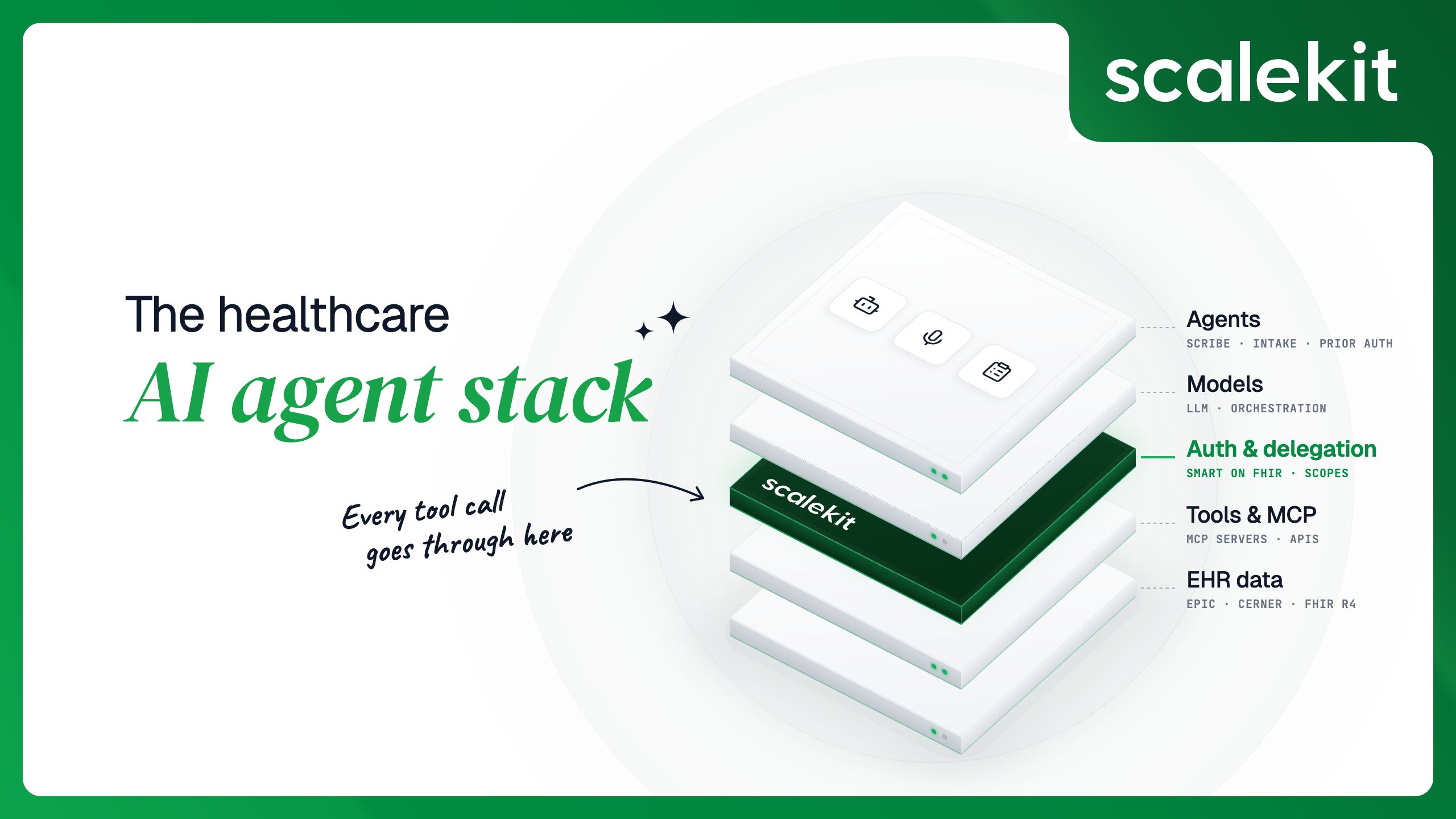
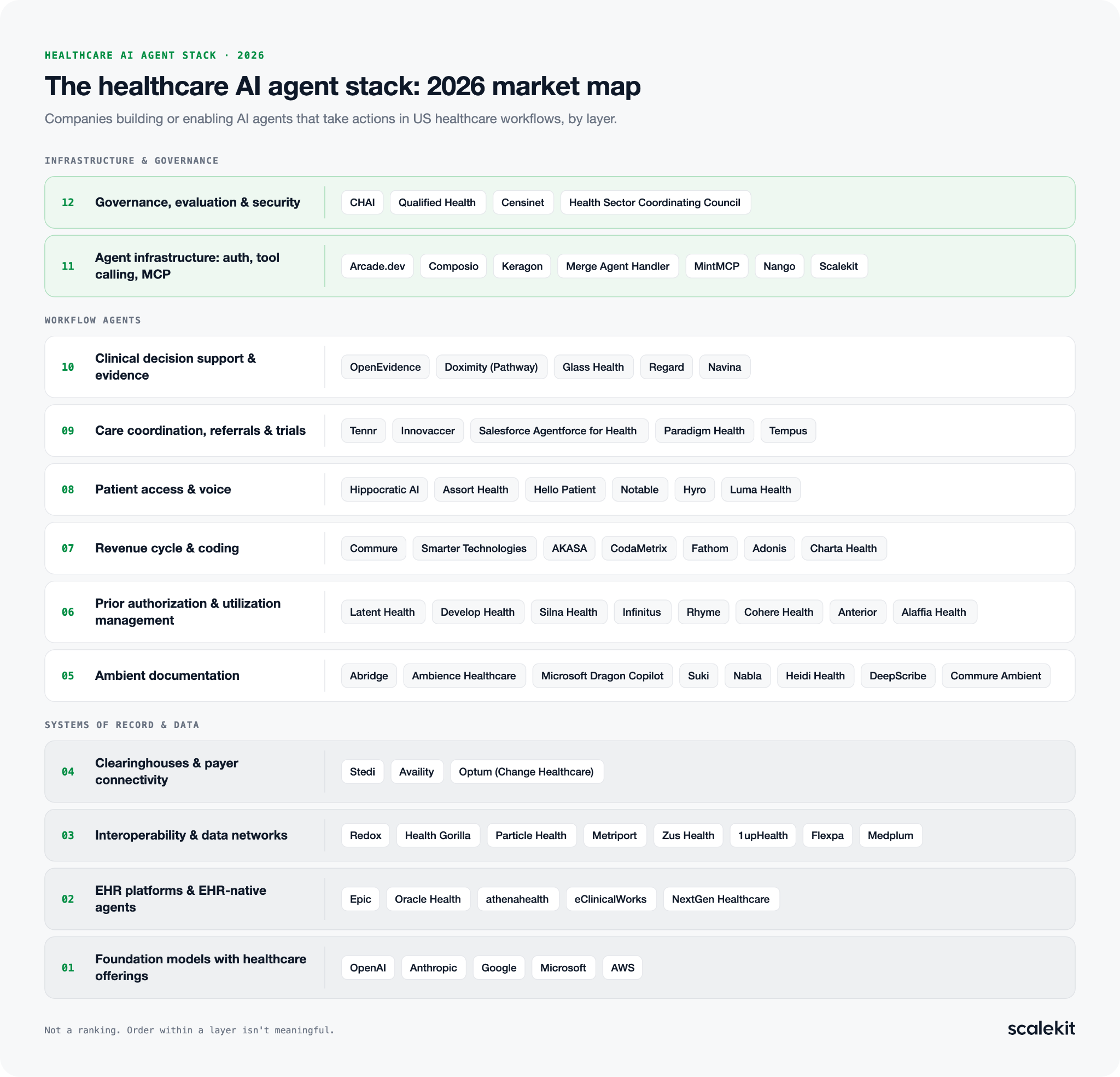
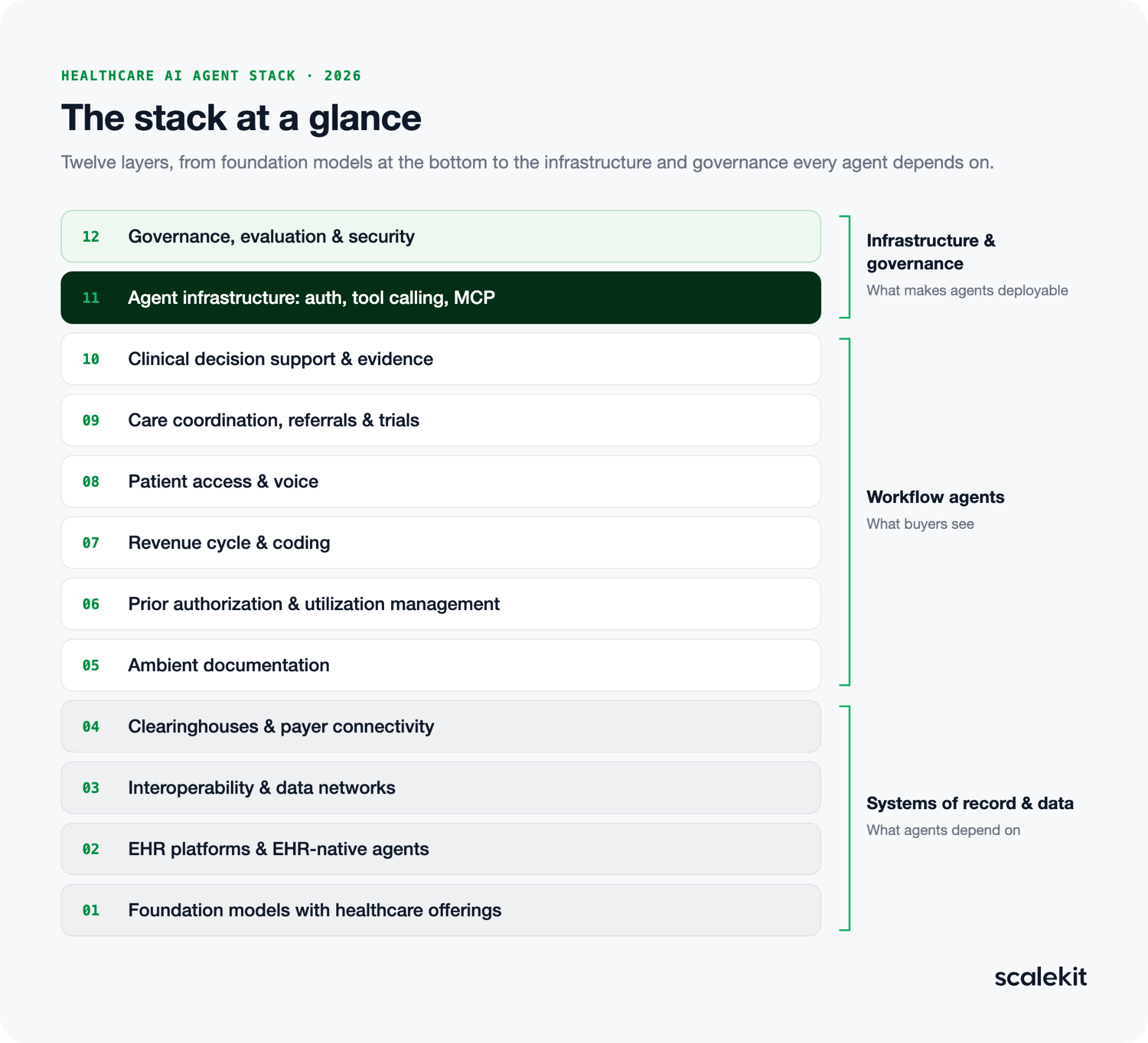
The stack has 12 layers, from foundation models and EHR-native agents at the bottom, through workflow agents (scribes, prior auth, RCM, patient access), to the infrastructure and governance layers every agent depends on.
Incumbents are building agents inside the EHR. Epic says more than 85% of its customers use Epic AI, and its Agent Factory lets health systems build their own. Independent agents have to work alongside them, through the certified APIs.
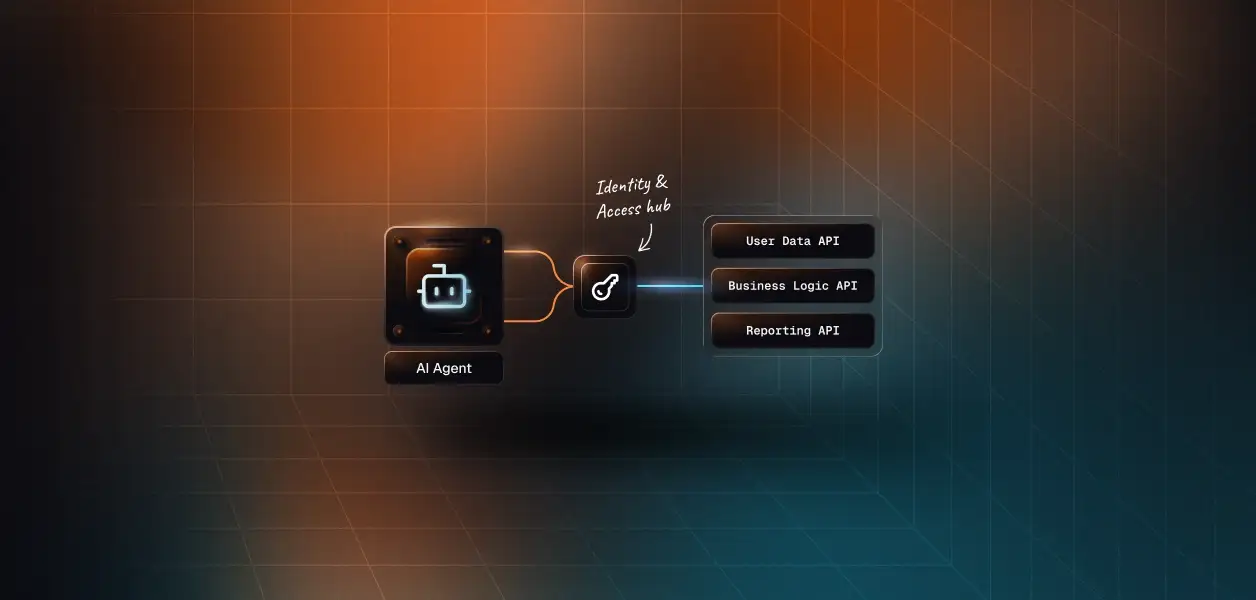
Every workflow layer depends on the same plumbing: authenticating to EHRs, payers, clearinghouses and SaaS tools as the right person, per health system, with an audit trail. That's the least visible layer on this map, and the one that decides which agents get deployed.
How we built this map
Scope: companies building or enabling AI agents that act in US healthcare workflows. That means taking actions in systems, not only answering questions.
Sources: company announcements, funding releases and trade press, linked inline. Metrics are company claims unless noted.
Not a ranking. Order within a layer isn't meaningful. We're one of the companies on the map (in agent infrastructure), so we've kept every description factual.
Corrections: if your company is missing or misdescribed, email us and we'll update it in the next quarterly refresh.
The stack at a glance
Layer 1: Foundation models with healthcare offerings
Model providers now ship healthcare-specific products, BAAs and connectors.
Company
What it offers for healthcare
OpenAI
ChatGPT for Healthcare (January 2026) with a BAA, data residency and customer-managed keys; API BAA; an Epic plugin with per-user SMART on FHIR login
Anthropic
Claude for Healthcare (January 2026) with CMS Coverage, ICD-10 and NPI connectors, plus FHIR and prior-auth skills
Google
MedGemma open health models; Gemini on Google Cloud's HIPAA-covered services
Microsoft
Dragon Copilot for clinicians, a partner-agent marketplace, and a healthcare agent service in Copilot Studio
AWS
HIPAA-eligible Bedrock and AgentCore, plus an open-source HealthLake MCP server
What to watch: BAAs are table stakes, but coverage differs by feature. Anthropic's BAA, for example, excludes data sent to third parties through MCP connectors.
Layer 2: EHR platforms and EHR-native agents
The systems of record are becoming agent platforms themselves.
Company
Agent activity
Epic
Art (clinicians), Emmie (patients) and Penny (revenue cycle); native AI Charting; Agent Factory, a no-code builder for health systems; real-time prior-auth checks with payers
Oracle Health
Clinical AI Agent in its new EHR, expanding into order creation, coding, dictation, chart review and nursing documentation
athenahealth
Agentic patient-communication tools across its network; a patient-facing MCP server in progress
eClinicalWorks
AI API Workbench for health systems to build their own agents; healow Genie contact center; Sunoh.ai ambient
NextGen Healthcare
Ambient Assist for notes synced to the EHR
What to watch: the EHR's own agents set the baseline. Independent agents win where they go deeper in a workflow or span systems the EHR doesn't.
Layer 3: Interoperability and data networks
These assemble records from many sources and give agents a longitudinal view.
Company
What it does
Redox
EHR integration network normalizing HL7 v2, CDA, X12 and FHIR; MCP server for managing Redox environments
Health Gorilla
TEFCA QHIN with clinical, lab and ADT data APIs
Particle Health
National network aggregator across Carequality, CommonWell and eHealth Exchange
Metriport
Open-source network access and patient data platform
Zus Health
Shared, aggregated patient record with FHIR and GraphQL APIs
1upHealth
Payer FHIR platform for CMS interoperability APIs
Flexpa
Patient-authorized claims and clinical data APIs
Medplum
Open-source headless FHIR platform with an MCP server
Layer 4: Clearinghouses and payer connectivity
The rails for eligibility, claims and prior auth.
Company
What it does
Stedi
API-first clearinghouse for eligibility, claims and remits; MCP server with real-time eligibility tools; raised a $70M Series B in 2025
Availity
Multi-payer network and APIs; partnered with Abridge on real-time prior auth at the point of care
Optum (Change Healthcare)
The largest legacy clearinghouse; its 2024 breach affected about 192.7 million people
What to watch: CMS-0057-F requires FHIR prior-auth APIs from impacted payers by January 1, 2027. Until then, agents run on both FHIR and X12, portals and fax.
Layer 5: Ambient documentation
The largest and most crowded agent category.
Company
Notes
Abridge
Enterprise ambient scribe; $300M Series E at a $5.3B valuation (2025); real-time prior auth with Availity
Ambience Healthcare
Ambient documentation with coding awareness; $243M Series C (2025); embedded in Epic
Microsoft Dragon Copilot
The incumbent, with the Nuance DAX lineage
Suki
AI assistant and scribe
Nabla
Ambient moving toward agentic workflows; $70M Series C (2025)
Heidi Health
AI care partner; $65M Series B (2025)
DeepScribe
Specialty ambient, with a focus on oncology
Commure Ambient
Ambient within Commure's RCM and operations platform
What to watch: EHR-native scribes (Epic AI Charting, Oracle, NextGen) are compressing the category. Differentiation is moving to write-back depth: orders, coding and prior-auth triggers.
Layer 6: Prior authorization and utilization management
Company
Side
Notes
Latent Health
Provider
Medication prior auth; $80M Series A (2026)
Develop Health
Provider
Prior auth and medication access for prescribers
Silna Health
Provider
Prior auth and benefits automation
Infinitus
Provider, pharma
AI agents for benefits verification, prior auth and patient communication
Rhyme
Network
Prior-auth exchange between providers and payers
Cohere Health
Payer
Utilization management platform; $90M Series C (2025)
Anterior
Payer
Clinical review automation for health plans; $40M Series B (2026)
Alaffia Health
Payer
Agentic claims review, payment integrity and appeals; $55M Series B (2026)
What to watch: CMS's WISeR model brings AI-assisted prior auth to traditional Medicare in six states from 2026, with licensed clinicians deciding every denial.
Layer 7: Revenue cycle and coding
Company
Notes
Commure
AI revenue cycle plus ambient; raised at a $7B valuation (2026)
Smarter Technologies
SmarterDx, Thoughtful.ai and Access Healthcare combined into one AI RCM company
AKASA
Generative AI for coding, prior auth and claims
CodaMetrix
Autonomous medical coding
Fathom
Autonomous coding
Adonis
AI revenue cycle orchestration; $40M Series C (2026)
Charta Health
AI chart review for coding and revenue integrity
Layer 8: Patient access and voice
Company
Notes
Hippocratic AI
Safety-focused voice agents for outreach and care; $126M Series C at a $3.5B valuation (2025)
Assort Health
Specialty voice agents for scheduling and intake; valued at $1.2B (2026)
Hello Patient
Conversational AI for the patient front door
Notable
Agents and a low-code builder for access, revenue cycle and care operations
Hyro
Voice and chat agents for health systems
Luma Health
Patient access platform with operational AI
What to watch: outbound AI calling falls under TCPA consent rules, which shapes how aggressively these agents can do outreach.
Layer 9: Care coordination, referrals and clinical trials
Company
Notes
Tennr
Automates fax-based referral intake; $101M Series C (2025)
Innovaccer
Agents for scheduling, intake and referrals; proposed a healthcare extension to MCP
Salesforce Agentforce for Health
Agents for referrals, coverage and care coordination on Health Cloud
Paradigm Health
Clinical trials embedded in routine care; $78M Series B (2025)
Tempus
EHR-based trial matching after acquiring Deep 6 AI
Layer 10: Clinical decision support and evidence
Company
Notes
OpenEvidence
Evidence engine for physicians; valued at $12B (2026)
Doximity (Pathway)
AI clinical reference after acquiring Pathway
Glass Health
AI differential diagnosis and clinical decision support
Regard
Diagnosis suggestions from chart data and conversations
This is the layer that connects workflow agents to the systems in layers 2–4 and to the SaaS tools around them. It handles authentication per user and per health system, tool calling, scoping and audit.
Company
Notes
Arcade.dev
Multi-user authorization for MCP tools
Composio
Tool-calling platform with a large catalog
Keragon
No-code healthcare automation with an MCP server (beta) for 30+ EHRs
Merge Agent Handler
Agent tool calling on Merge's integration platform
MintMCP
MCP gateway marketed for HIPAA environments
Nango
Integrations and data sync with agent tool calling
Scalekit
Auth and tool calling for agents: per-user delegated access, SMART on FHIR for any FHIR server, self-hosted option
Why this layer matters more in healthcare: a single prior-auth agent may need a clinician's SMART on FHIR token, payer credentials, a clearinghouse key, a portal login and a fax key, for every user at every health system. How these credentials are held, scoped and logged decides whether a health system's security review passes. We compared the options in Best Agent Integration Platforms for Healthcare.
Layer 12: Governance, evaluation and security
Organization
Notes
Coalition for Health AI (CHAI)
Responsible AI guidance with the Joint Commission, model cards, and an agentic AI work group
Qualified Health
Generative AI platform for health systems with oversight and monitoring; $125M Series B (2026)
Censinet
Third-party and AI vendor risk management for healthcare
Health Sector Coordinating Council
Third-party AI risk and supply-chain transparency guidance (2026)
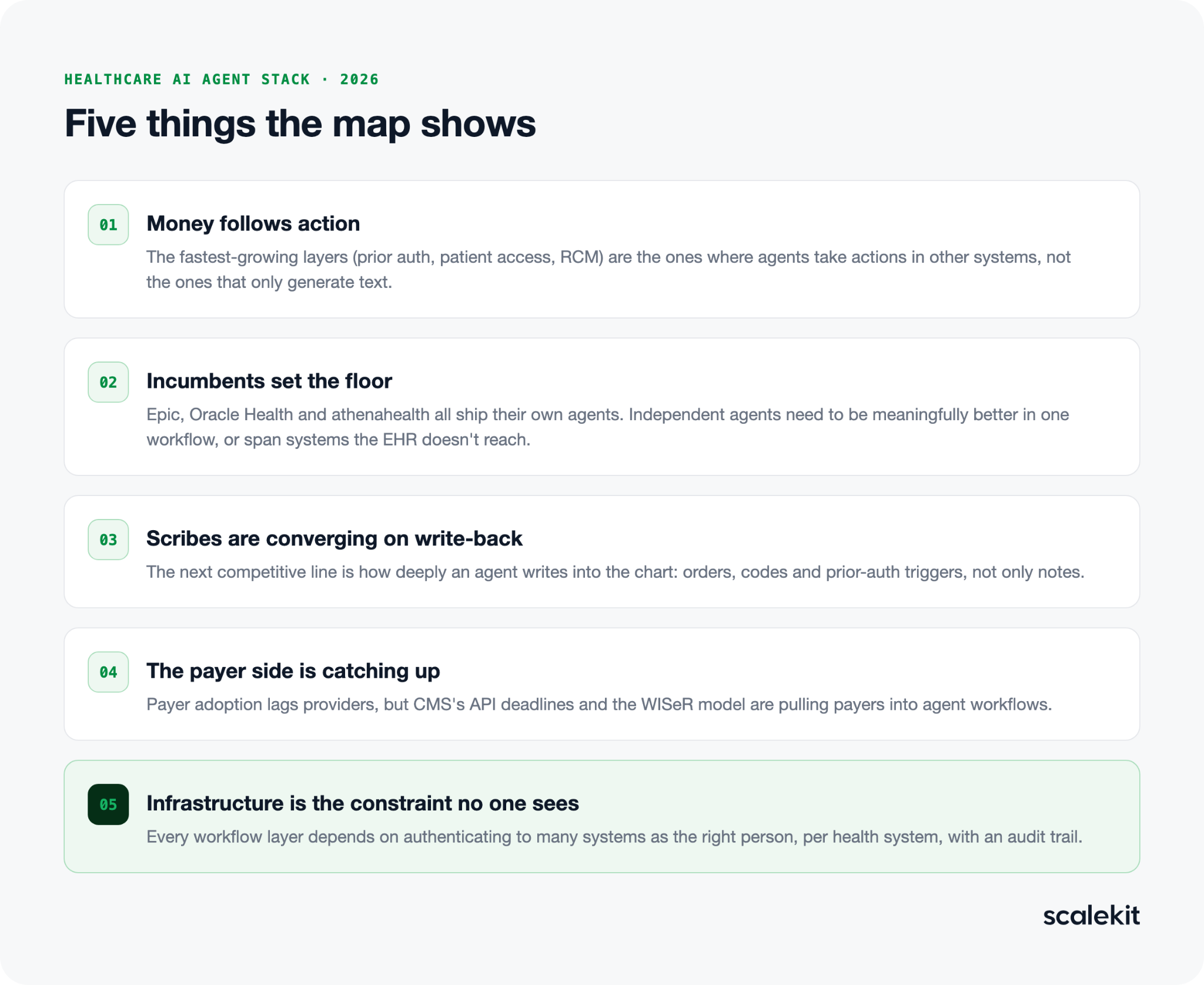
Five things the map shows
Money follows action. The fastest-growing layers (prior auth, patient access, RCM) are the ones where agents take actions in other systems, not the ones that only generate text.
Incumbents set the floor. Epic, Oracle Health and athenahealth all ship their own agents. Independent agents need to be meaningfully better in one workflow or span systems the EHR doesn't reach.
Scribes are converging on write-back. The next competitive line is how deeply an agent writes into the chart: orders, codes and prior-auth triggers, not only notes.
The payer side is catching up. Payer adoption lags providers, but CMS's API deadlines and the WISeR model are pulling payers into agent workflows.
What are the main categories of healthcare AI agents?
The main workflow categories are ambient documentation, prior authorization and utilization management, revenue cycle and coding, patient access and voice, care coordination and referrals, and clinical decision support. They sit on top of foundation models, EHR platforms, data networks and clearinghouses, and depend on agent infrastructure and governance layers.
Which healthcare AI agent category is largest?
Ambient documentation. Menlo Ventures estimated $600M of 2025 spend on ambient scribes, the largest single category, followed by coding and billing at $450M. Prior authorization and patient engagement were the fastest-growing, at roughly 10x and 20x.
Are EHR vendors building their own AI agents?
Yes. Epic ships Art, Emmie and Penny plus Agent Factory for health systems to build their own. Oracle Health has its Clinical AI Agent, and athenahealth and eClinicalWorks have launched agentic tools. Independent agents integrate alongside them through certified FHIR APIs.
What is agent infrastructure in healthcare?
Agent infrastructure is the layer that lets AI agents act in other systems safely. It covers authenticating to EHRs, payers, clearinghouses and SaaS tools on behalf of specific users, scoping which tools each agent can use, handling token lifecycle, and logging every action for audit, often deployed inside the customer's cloud.
How is this market map maintained?
We refresh it quarterly from company announcements, funding releases and trade press. Companies that are missing or misdescribed can email us for a correction. Inclusion isn't a ranking or endorsement.




.webp)