

Pricing AI agent infrastructure is hard. In the early days of the AI stack, per tool-call usage based pricing made sense: developers get simple forecasting. But as AI agents move from simple API integrations to multi-agent workflows, pricing factors need to be revisited.
Composio announced upcoming changes to their pricing, effective August 15th. If you're building on it or evaluating, it's worth understanding exactly what moved, because this pricing change is more nuanced than the plan names and headline prices suggest. We've mapped out what's actually different and what it means at real usage volumes.
Full disclosure: we operate in the same space as Composio, as a close competitor, so we obviously have a vested interest in how their pricing is shaped. But this space is also genuinely new. All of us, Composio included, are still figuring out the right value metrics and the right usage-based pricing that actually aligns with what customers get out of these products.
So we went deep on what actually changed, and what it looks like in practice for both existing and new Composio customers. We thought it was worth documenting clearly for anyone trying to understand what this really means and how to think about it.
Quick comparison of pricing changes below
The old pricing page priced one thing: tool calls. The new structure breaks out several more meters that are worth checking against your actual usage pattern, not just your call volume:
None of these are large individually. But if your agent leans on triggers, the sandbox, or premium tools (video generation and similar), they add up alongside the tool-call overage above.
Two smaller but real changes worth a mention:
Both are worth checking if compliance requirements are part of why you're on a given plan.
Abstract percentages don't tell you much. Here's what the change looks like at four realistic points on the usage curve. New-plan figures use the $29/mo Pro base, since Business's $599/mo buys support and compliance features, not a bigger call allowance (more on that below). All figures assume standard tool calls only, at the standard $4/1K overage rate; this doesn't include trigger events, LLM tokens, premium tool usage, sandbox, or storage, which bill separately and would add to the numbers below depending on your usage pattern.
The pattern: the increase is mild right at the edge of the free tier, and gets dramatically worse the more real usage your agent has. That's the part worth sitting with. This pricing change lands hardest exactly where most teams consider themselves to be succeeding.
Beyond the metering changes above, a few core features moved (or now clearly sit) behind specific tiers in ways worth knowing before you commit. Notably, who holds your OAuth tokens is now a paid decision — self-managed credentials are a Business-tier-only feature:
The one worth pausing on: below $599/mo, you don't get a choice about who holds your credentials. If credential custody matters to your security posture (and for most teams handling real customer data, it should), that's not a Pro-tier feature anymore.
Whenever a major infrastructure layer restructures its pricing, the immediate conversation in developer communities turns to cost modeling and architecture.
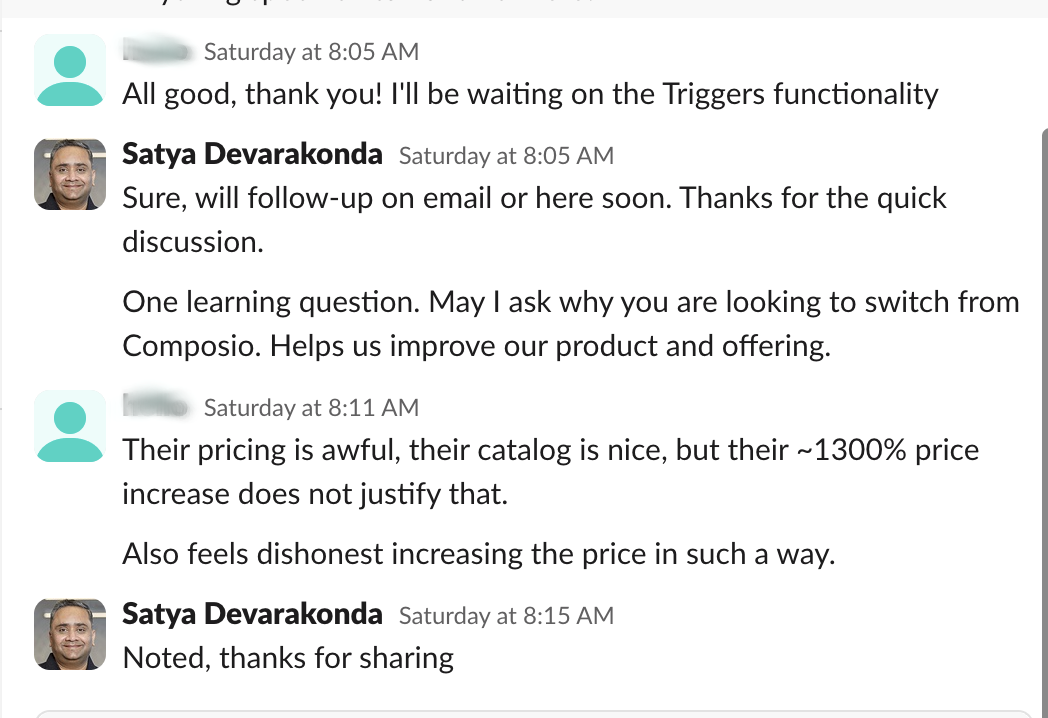
One conversation from our own community captures the range of reactions well. A builder evaluating a switch put it plainly: the catalog is genuinely good, but a roughly 13x jump in cost doesn't track with the value they were getting, and it felt less like a routine price update and more like being handed a different product.
We'd push back on part of that read.
"Dishonest" is too strong a word for what happened here: Composio published the new numbers, gave four and a half months of notice, and grandfathered every existing customer through the end of the year. That's a real, above-board transition, not a bait-and-switch.
Where we don't push back: the magnitude. Going from $229/mo to somewhere in the $6K–$8K/mo range for the same 2M-call workload isn't a rounding error you smooth over with a roadmap conversation.
If you're at that scale on Composio right now, or planning to be by year-end, that's not a "watch and see" number. It's a "model it out this quarter" number.
To Composio's credit: existing customers, and anyone who signs up before August 15, keep their current plan and limits through December 31, 2026.
It's a timeline deadline, not a reprieve. If you're currently on the $229/mo plan running meaningful volume, the question isn't whether the new rates apply to you; it's when. Modeling your cost under the new structure now costs nothing and tells you exactly how much time you actually have before the economics change.
A few honest takeaways, roughly in order of how much they should change your near-term plans:
Usage-based pricing makes this kind of repricing possible in a way flat pricing doesn't. That's not unique to Composio; it's structural to consumption pricing across this category. Worth weighing pricing model, not just headline price, when you're choosing infrastructure you plan to depend on for years, not months. Understanding how tool calling auth changes as you scale from single-tenant to multi-tenant is equally important to factor into that decision.
Whether you choose Composio, Scalekit, or build in-house tool routing, consider these criteria when picking agent infrastructure:
We wrote a straight-up migration guide a while back for teams moving off Composio for security reasons, and the mechanics there (SDK swap, tool naming, auth flow) apply the same way here, regardless of why you're moving.
If you want to actually model what your specific usage looks like under Composio's new structure, or how it'd compare running on Scalekit, we're happy to do that math with you directly rather than have you guess. Book a call or reach out and we'll find time.
Sources: composio.dev/pricing and composio.dev/updated-pricing, retrieved August 2026. New pricing takes effect August 15, 2026; figures above reflect both pages as published at that time and may change. Check Composio's pages directly for current terms.