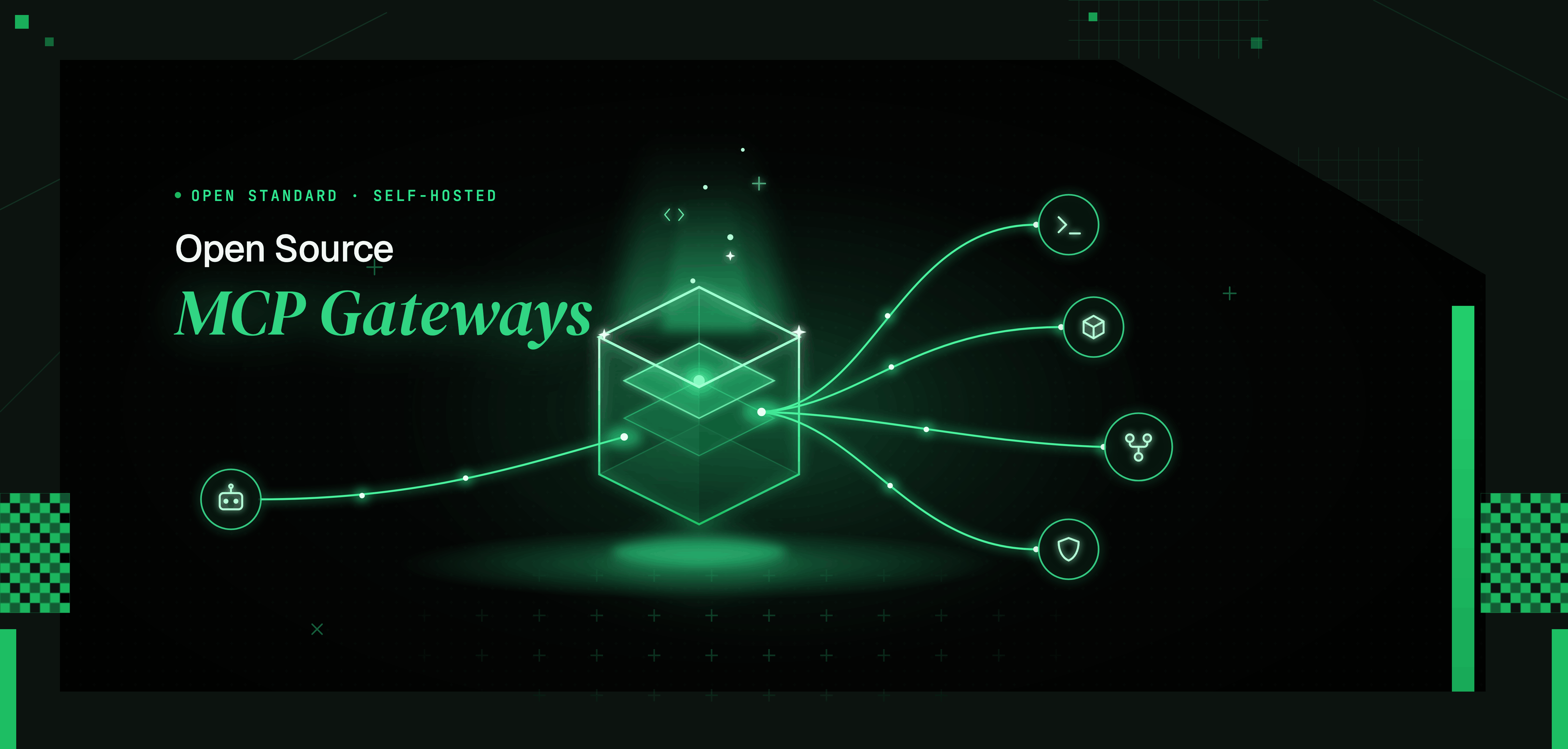


Self-hosting a gateway is its own decision, separate from which governance features matter most — you're trading a managed product for full inspection rights, no vendor lock-in, and the operational work of running it yourself. Here's what's genuinely open source in this space today, with the specifics that actually separate them.
Lunar's open source MCP gateway and AI control plane, giving a single governed entry point for every agent-to-tool interaction. The open core handles aggregation, access control, and observability; deeper governance — SSO/RBAC, secret isolation, automated MCP server risk scoring, hosted deployment — sits in a separate Enterprise tier.
What's good:
Current gaps:
Best fit: teams that want an open-source foundation with a credible, well-documented path to enterprise governance if they need it later.
Docker's approach treats MCP servers as container workloads — each one isolated with its own CPU and memory limits, cryptographically signed images for supply-chain security, registered dynamically, deployed through familiar Docker Compose or Docker Desktop.
What's good:
Current gaps:
Best fit: teams already standardized on Docker/Kubernetes, prioritizing container isolation and comfortable owning the governance layer themselves.
An open-source, MIT-licensed Kubernetes-native reverse proxy for session-aware routing and lifecycle management of MCP servers you already run. It routes and orchestrates — it doesn't convert REST APIs into MCP tools. Microsoft's separate, commercial path is Azure API Management acting as an auth and security gateway for MCP traffic, leveraging Azure APIM's existing scale.
What's good:
Current gaps:
Best fit: Azure-native shops extending existing API governance to cover MCP traffic specifically.
The option in this list built specifically for one job the others aren't: a single federated control plane connecting AI agents to MCP tools, A2A agents, and REST/gRPC APIs across multiple clouds and regions — without standing up a separate gateway stack per region. An open-source registry and proxy (published on PyPI as mcp-contextforge-gateway) that federates all of this behind a single endpoint. Its standout capability is protocol translation — converting existing REST and gRPC services into MCP-compatible tool definitions, plus "virtual server composition," letting multiple MCP servers appear as one logical endpoint to an agent.
What's good:
Current gaps:
Best fit: large organizations with sophisticated DevOps teams that need genuine multi-protocol federation and can absorb the operational and support tradeoffs that come with it.
The most complete open-source bundle on this list — an MIT-licensed gateway, server catalog, hosting, and chat client shipped as one deployment, running on Kubernetes or Docker.
What's good:
Current gaps:
Best fit: teams wanting the broadest functionality out of a single open-source deployment, with a credible upgrade path if enterprise IdP integration becomes a requirement later.
Worth naming directly: most teams reaching for "open source" here aren't actually optimizing for inspectable code. They're optimizing for two things open source happens to guarantee — data never leaving infrastructure you control, and no dependency on a vendor's hosted uptime. Self-hosting is one way to get both. It's not the only way, and it comes with a real cost: you own every upgrade, every patch, and every part of running it going forward, with no vendor support to call, and (per the gaps above) inconsistent depth in exactly the governance features that were probably the point of wanting a gateway at all.
Scalekit's Agent Gateway isn't open source, and it's worth being direct about that rather than implying otherwise. What it does offer is a fully on-prem, air-gapped deployment option — your infrastructure, your data never leaving it — but with consistent managed upgrades and enterprise support behind it, instead of your team owning that maintenance alone, and without the governance-depth gap that shows up in nearly every open-source option above once you look past the open core. For a lot of teams, that's a better match for what they were actually trying to get from "open source" in the first place: real ownership of where the data lives, without also taking on being your own release-engineering and security-patching team indefinitely.
If code inspection itself is the actual requirement — not just data control — the open-source options above remain the right category to be looking at. Understanding MCP security risks in the enterprise is worth doing regardless of which deployment model you choose.
No. It offers on-prem and air-gapped deployment, which addresses data-residency and control concerns the way self-hosted open source does, but the code itself isn't open. Teams evaluating MCP authentication build vs. buy decisions should factor in operational overhead alongside licensing terms.
Not fully — you can't fork or inspect the code, and you're still depending on the vendor for updates and support. What it removes is the operational burden of running and patching the software yourself, and your data still never leaves your infrastructure. Whether that trade-off is equivalent depends on whether code inspection or data control was the actual requirement.
Usually not fully — most split a genuinely open core from a paid tier that adds Okta/Entra/Google Workspace federation. Obot's core does include GitHub and Google IdP without payment, but Okta and Entra specifically require its Enterprise Edition — check exactly where each vendor's line sits rather than assuming. For teams evaluating how enterprise MCP identity and SSO actually work, the distinction between open-core IdP support and full enterprise federation matters significantly.
Beyond the software itself: connector runtime management, credential handling and rotation, observability, and keeping up with updates — all work a managed product would otherwise absorb. IBM ContextForge in particular is explicit that its governance depth still trails its federation capabilities, meaning even after standing it up, some of the governance work may still be manual. Agent tool observability is one area where the gap between open-source tooling and a managed platform tends to show up quickly in production.
At meaningful scale, yes. A Python-based gateway like ContextForge carries higher per-request overhead than a Go-based alternative — not disqualifying, but worth factoring in if you're routing high volumes of agent traffic rather than running a handful of internal tools.
Of the options here, IBM ContextForge is built for exactly this — multi-cluster federation with auto-discovery across distributed deployments, plus the ability to federate MCP alongside A2A agent traffic and REST/gRPC APIs in the same runtime. None of the other four options in this list are built primarily for that use case. Teams thinking about access control for multi-tenant AI agents at this scale should evaluate governance depth alongside federation capabilities before committing to a deployment model. It's also worth understanding the difference between MCP and APIs when planning your integration architecture.