Virtual MCP Servers

Connect your agents to any tool. Authenticated, scoped, and logged.

500+ connectors and 20,000+ actions behind one endpoint. You build the agent — we handle every integration between it and the tool.
npx @scalekit-inc/cli setup

Trusted by teams shipping agents to production

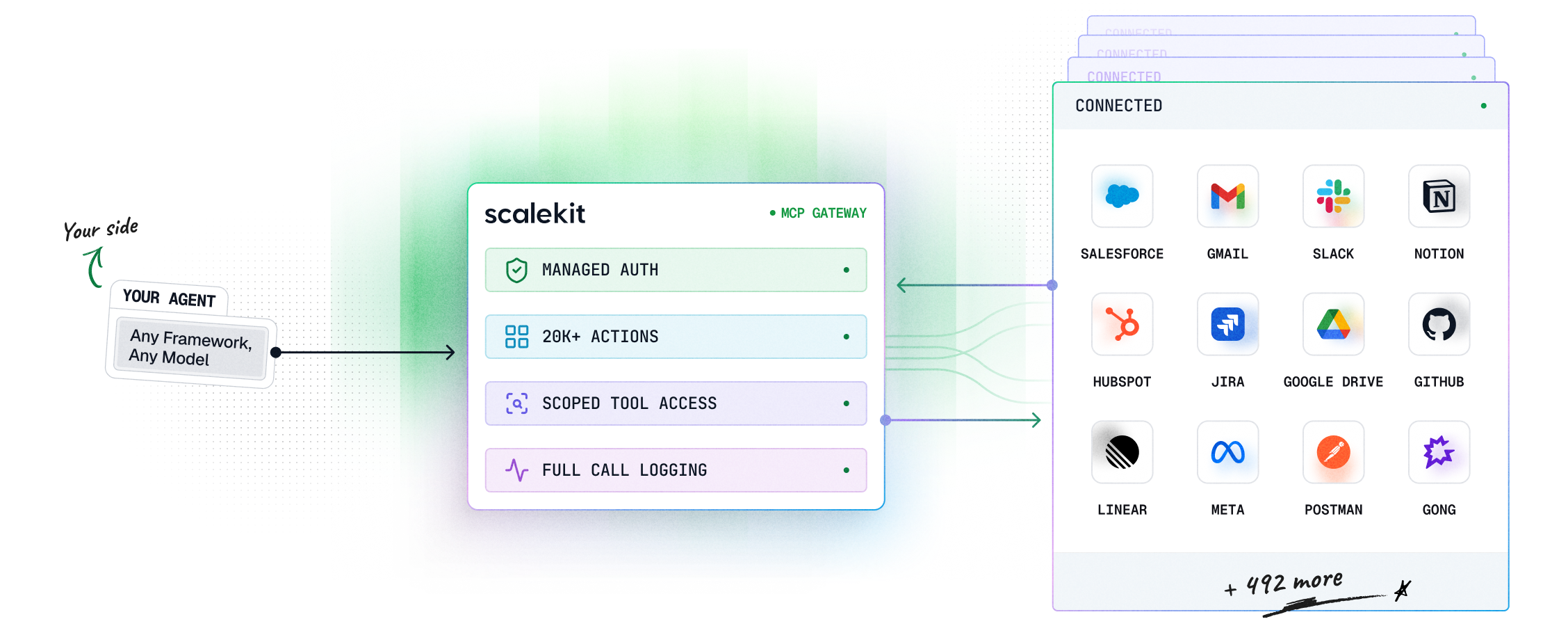
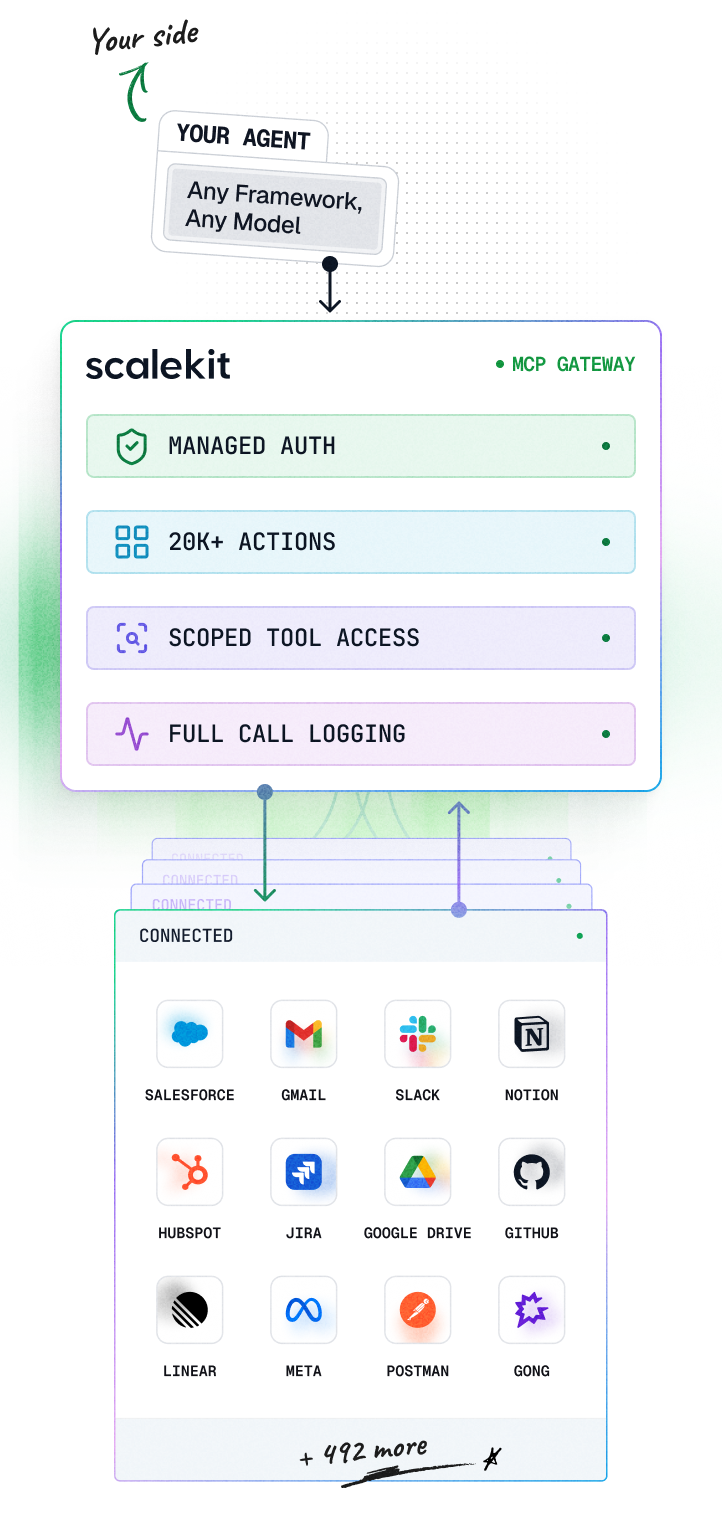
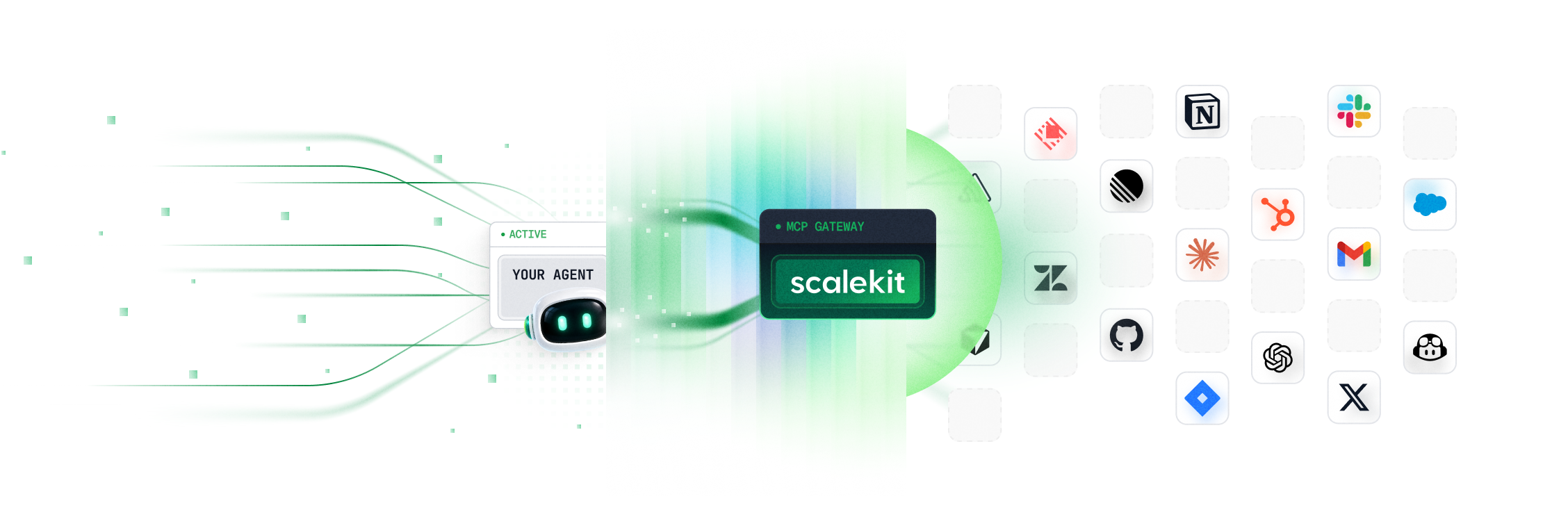
One MCP gateway between your agent and every toolit calls.

The right credentials, a permission check, a clean request and a readable response. Handled on every call, so you build the agent, not the integration layer.
Managed auth
Users connect their own accounts. We store the tokens, refresh them, and attach them to every call. Nothing lands in your code.
20K+ actions
Across 500+ connectors — to call on demand, or to start a run when something happens in your user's world. No polling, no cron.
Scoped tool access
Decide which tools each agent role can see. One endpoint per role, one session per user, enforced at the gateway and not in your prompt.
Logs on every call
Which agent, which user, which tool, what came back. Searchable, exportable, and streamable to Datadog, Splunk, or any SIEM.

500+ connectors.

20,000
actions.
CRM, email, calendar, tickets, docs and billing. Every tool is written for a model to read, so your agent picks the right one and sends the right arguments.
Granola
Windsurf
Gitlab
Meta
Sentry
Monday
Webflow
Zendesk
Cursor
Raycast
Attio
Linear
Google Calender
GitHub
Claude
Loom
YouTube
Notion
Google Docs
Jiminny
Outreach
Intercom
Clari
Jira
Codex
X (Twitter)
Salesforce
GitHub Copilot
Slack
LinkedIn
Vercel
Gmail
Trello
Postman
Vs Code
Apify
Close
Box
Affinity.co
Gong
Apollo
Vimeo
Google Drive
ChatGPT
Van Aarsen
Freshdesk
Atlassian
Gemini

More control over every tool call. Scope it, trigger it, extend it.

Decide which tools each agent gets, what starts a run, and what to add beyond the catalog.
Virtual MCP Servers

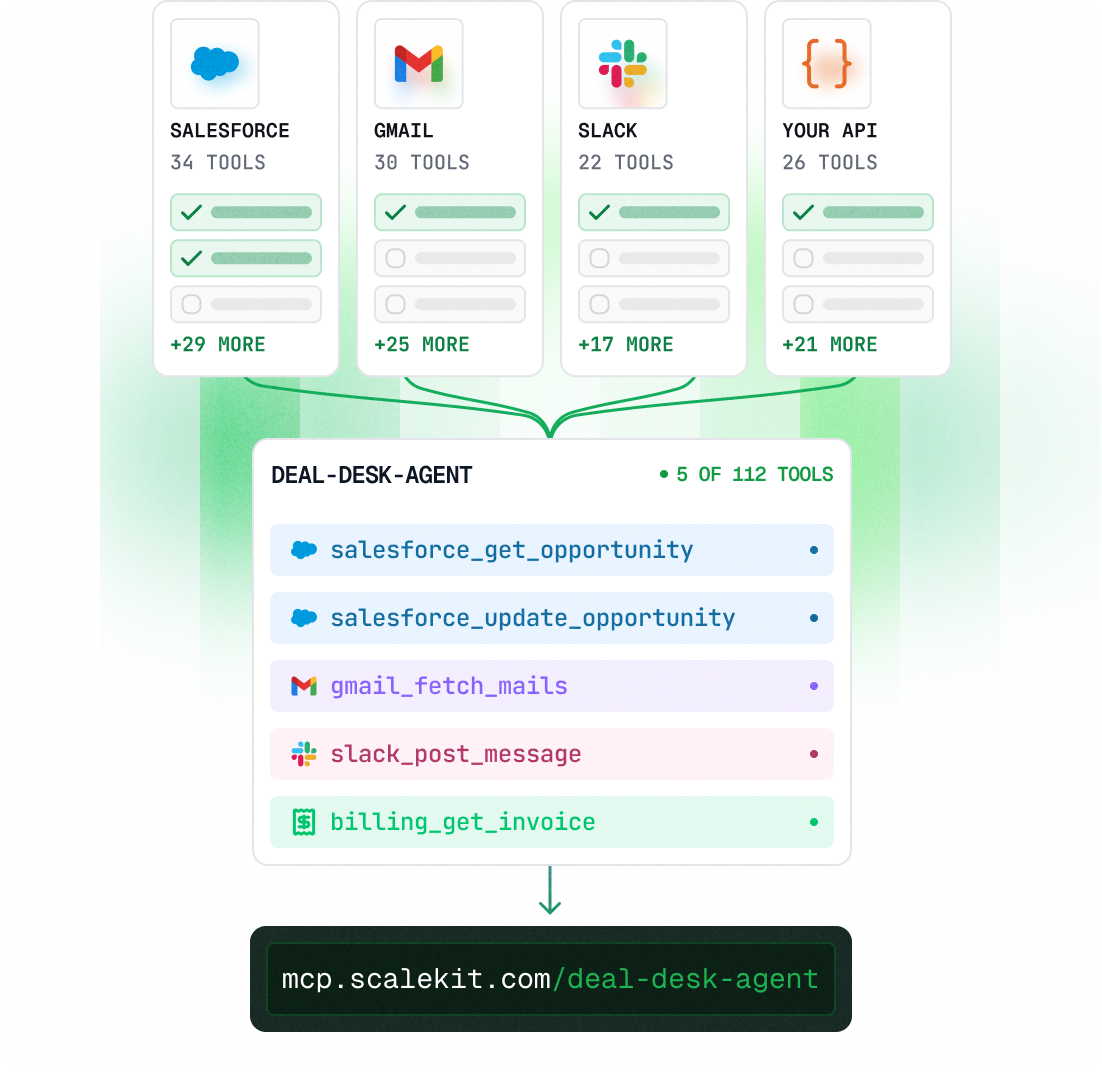
Build a tool set for each agent.
‍From any app, behind one endpoint.

Connect four apps and your agent sees 100+ tools. Give it the five its job needs, picked from any app and served as one endpoint.
Leaner context. Around 80% less tool overhead.
Just the right access. Each agent gets its role's tools, nothing more.
Same job, same result. It only sees the tools you chose.
Triggers

Run agents on events,
‍not prompts.

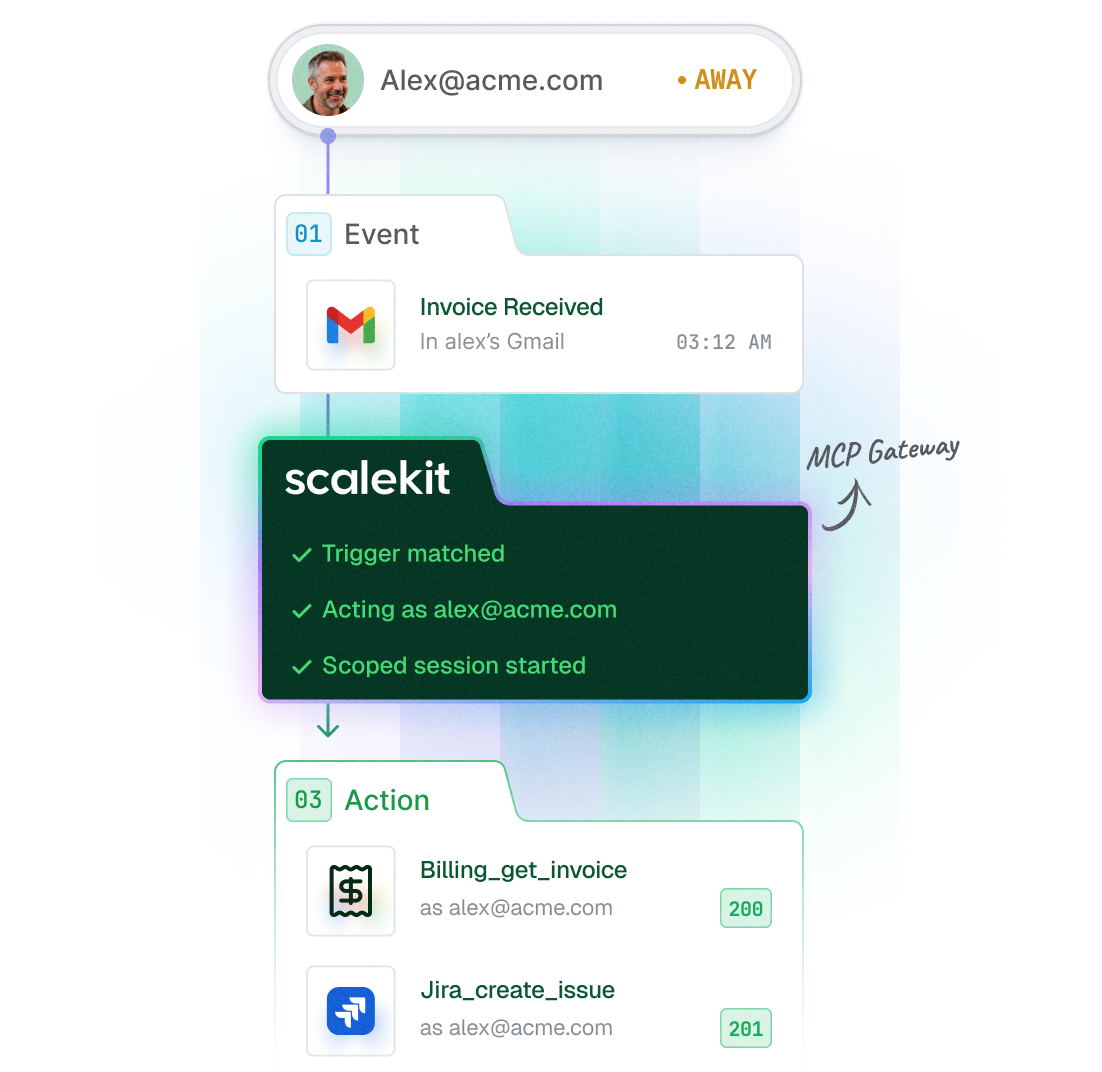
Something happens in your user's world — new mail lands, a charge clears, a record changes — and their agent runs against it. No polling loop, no cron job, no re-auth round trip before it can act.
The event carries auth context. The agent acts as that user from the first call, with nothing to re-establish.
No polling infrastructure to own. No queue to run, no watermark to track, no duplicate-delivery logic to get right.
Reactive, not request-driven. The difference between an agent that answers your users and one that works for them.
Custom tools & connectors

Add any API
‍to your tool catalog

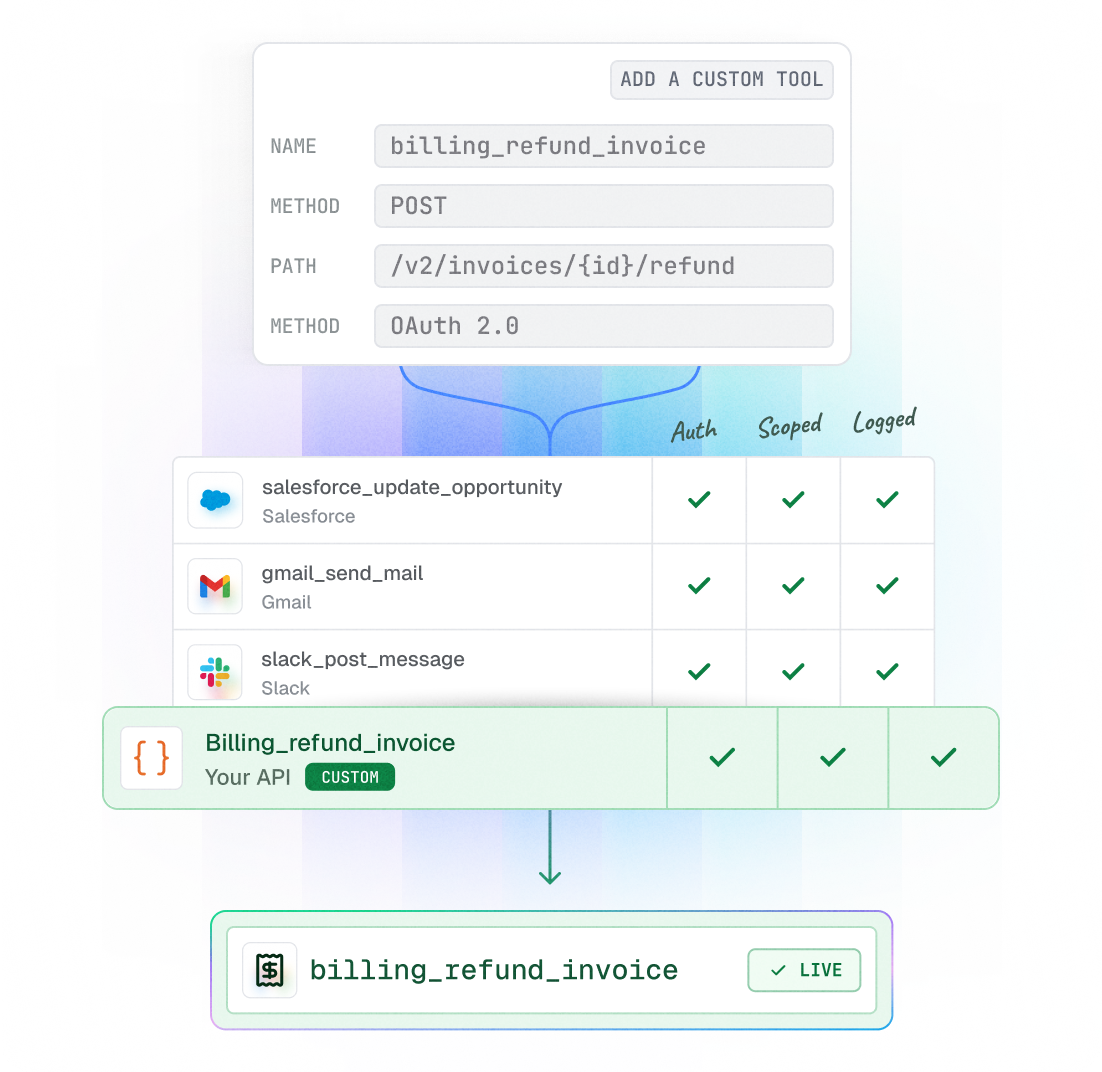
Point a schema at any endpoint on a connector you already have, or register a new one — an internal service, a partner API, a remote MCP server. Extend the catalog without standing up a second auth stack to maintain.
Custom tools: a schema pointed at an endpoint on a connector you already use. Roughly thirty minutes.
Custom connectors: a whole new system, on OAuth 2.0, API key, bearer token, RSA, or basic auth.
Identical at runtime. Same vault, same per-user scoping, same logs as anything in the catalog.
Credentials never touch your code.

Or your agent's context.

Users connect their accounts once. After that we store the tokens, keep them fresh, and attach them to each call your agent makes.
Connected accounts
Each user connects their own
Your agent acts as that person, in their data, with the permissions they granted. One user's agent can't reach another user's accounts.
Token vault
Encrypted, isolated, out of reach
Tokens sit in an AES-256 vault, isolated per tenant, and we attach them to the outbound call. Refresh and rotation run in the background.
Every auth model
OAuth, API keys, JWTs
OAuth 2.0, API keys, bearer tokens, and custom JWTs across all 500+ connectors — behind a white-labelled consent flow on your own domain.

See every tool call your agents make.
And who they made it for.

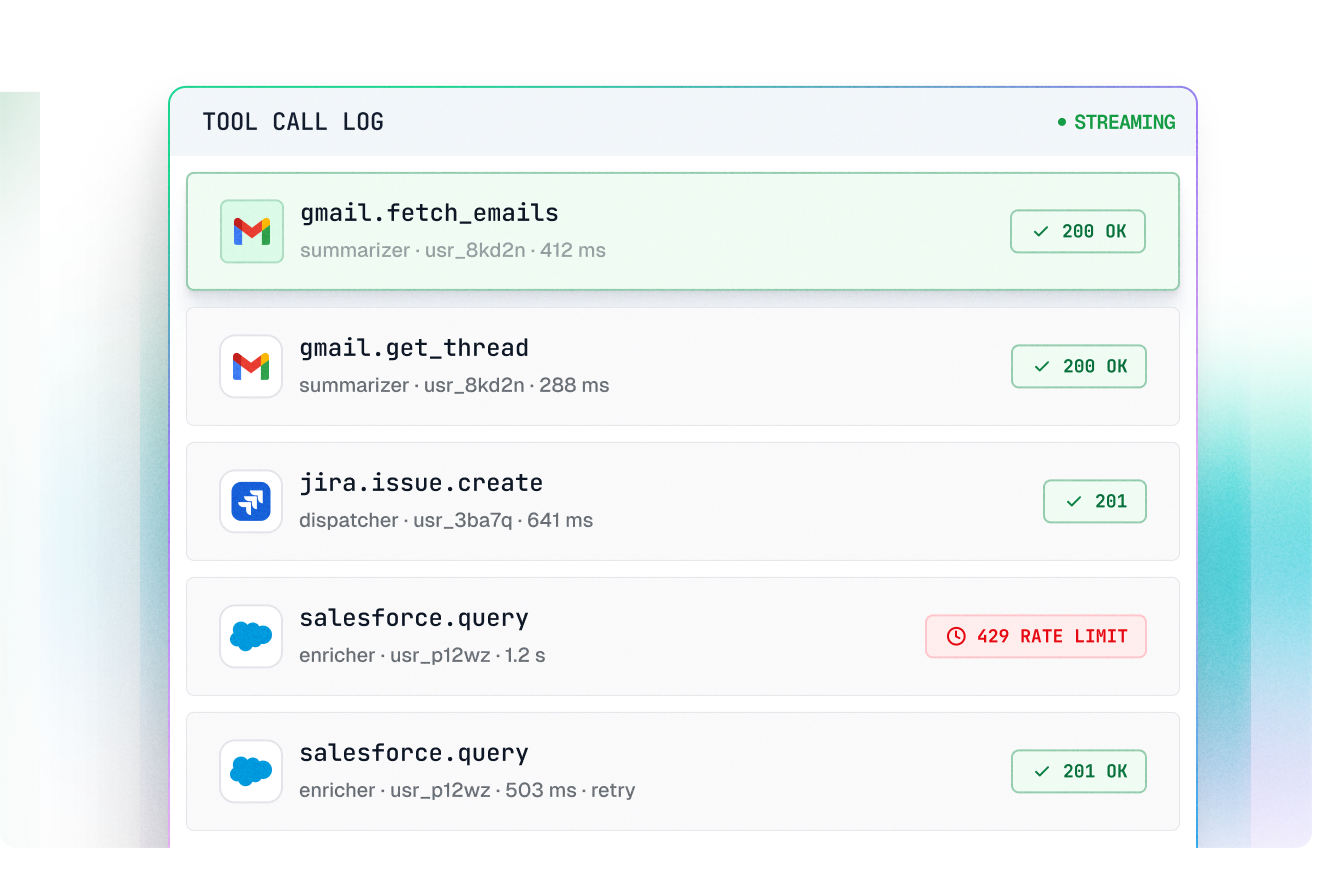
Full attribution on every call
Which agent ran it, which user authorized it, which tool it hit, and what came back. No reconstructing it later from application logs.
Streams to your SIEM
Send calls to Datadog, Splunk, or any SIEM as they happen. Attribution travels with them, so events arrive ready to use.
Failures you can act on
A rate limit, a revoked grant, and a bad argument are three different problems. The logs tell you which one you're looking at.
Works out of the box with any agent framework
Anthropic
OpenAI
Langchain
Google ADK
Mastra
Vercel AI
Openclaw
Claude code