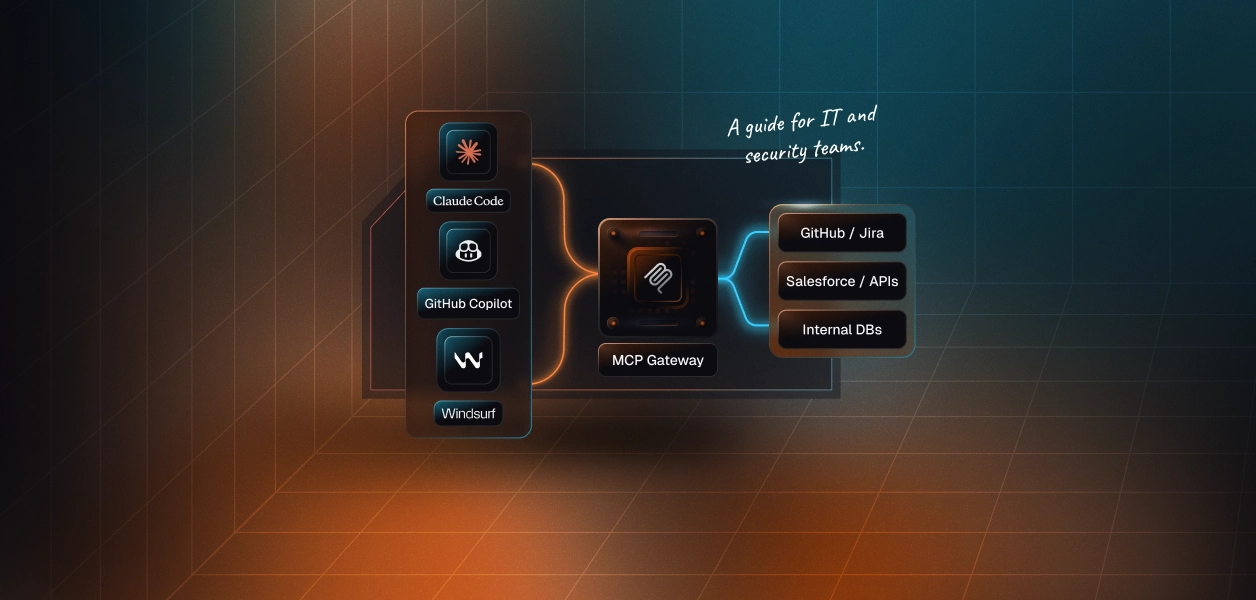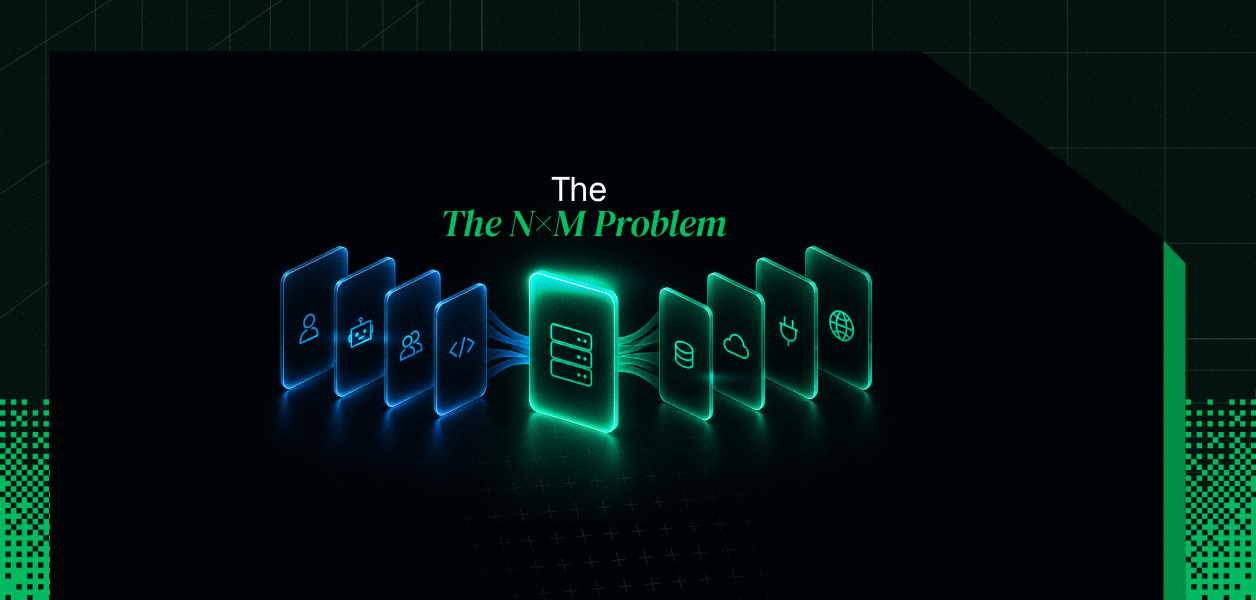


A two-agent prototype that touches three tools is easy. You wire each agent to each tool, hardcode a few credentials, and it works. The trouble starts when the prototype becomes a product. Now you have several agents, a dozen tools, and a growing list of customers, each with their own accounts. The number of connections you maintain stops growing in a line and starts growing like a grid.
That grid is the N×M problem, and a virtual MCP server is one of the main ways teams tame it. The useful question is not whether the pattern works, but at what point it earns its place in your deployment. To answer that well, you have to separate two different N×M problems that are easy to conflate:
Before MCP, connecting M AI applications to N tools meant building and maintaining up to M times N bespoke integrations. The Model Context Protocol collapses that grid by giving both sides one protocol to implement, which turns M×N into M+N. Each tool speaks MCP once, each client speaks MCP once, and any client can then reach any compliant server.
This is not a novel trick. MCP took the approach directly from the Language Server Protocol, which solved the same grid for code editors and programming languages. The same standardization logic explains the common shorthand for MCP as a universal adapter for AI tools. The key point for a deployment decision is narrower than the marketing: what MCP standardized is the wire format and the discovery model, not the operation of your fleet.
Here is the part that catches teams out. MCP solves N×M at the protocol layer, but a second N×M lives at the operational layer, and that one does not disappear because the wire format is uniform. Every remote MCP server you run still needs its own authentication, its own credentials, its own scopes, and its own hosting. Standardizing how a call is framed does nothing to standardize who is allowed to make it or where the server runs.
The operational grid concentrates in a few predictable places:
The authentication piece deserves emphasis, because it is where most of the operational N×M hides. The MCP authorization framework specifies OAuth 2.1, and current guidance for production remote servers is to use PKCE-protected flows, expose protected resource metadata for discovery, and validate the audience claim on every token. One rule matters more than the rest: a server should never pass a client's token straight through to a downstream API, and should obtain a separately scoped token instead. Doing that correctly once is real work. Doing it once per server, per provider, is the operational N×M in plain sight.
Choosing how to deploy is really choosing who absorbs that operational grid. Four broad options come up in practice, and they map onto how MCP servers are commonly categorized as workstation, managed, and remote deployments:
STDIO is the right answer for a tool you run on your own laptop, and the wrong answer the moment more than one user or one machine is involved, because it has no real concurrency story and no natural place to enforce auth or audit. The further down the table you go, the more of the operational N×M someone else absorbs. The scoped vMCP option absorbs the most, which is why it tends to win for multi-tenant products.
One protocol detail shapes the self-host decision more than people expect. The latest stable MCP specification, dated 2025-11-25, treats MCP as a stateful protocol, and stateful sessions are awkward to scale horizontally because a session pinned to one process fights with load balancers. If you self-host, that awkwardness is your problem to engineer around.
A stateless rework is published as a release candidate dated 2026-07-28, and it is not the final specification as of mid-2026. The practical guidance is to design against the stateful model today while planning for the stateless one. A managed or virtual endpoint is attractive partly because it absorbs this churn on your behalf, rather than leaving you to re-architect transport and session handling as the spec matures.
The pattern earns its place at a fairly predictable threshold. The clearest signals are below:
It is equally important to know when this is overhead you do not need yet. If a single connector serves one trusted user, or you have no multi-tenant or audit obligations, the simpler deployments are enough. Adopt the pattern when reach, identity, and operational load actually become the constraint, not before. The earlier sections describe what each option costs; this is simply the point at which the heavier option pays for itself.
Scalekit's vMCP implements the fourth option from the matrix above. It is worth being precise about what it does and does not claim. It does not re-solve the protocol N×M, since MCP already did that. It collapses the operational N×M to roughly N×1 at the credential layer, so that every connector inherits the same vault and audit chain rather than a fresh auth stack each time.
The mechanism is a managed, scoped endpoint plus a per-user identity model:
This design follows the same rule that the authorization guidance insists on. Rather than forwarding a client's token to a downstream provider, Scalekit resolves a separately scoped credential for the authorizing user on each call.
For teams with data-boundary requirements, the same model is available either as a Scalekit-hosted endpoint or deployed in your own cloud, so the deployment decision does not force a choice between control and convenience.
A short, documented path takes you from the model to a running endpoint.
More Resources:
MCP took the integration grid from M×N down to M+N at the protocol layer, and that is settled. The decision in front of you is about the second grid, the operational one made of auth, credentials, and hosting per server. Every deployment option is a different answer to a single question: who absorbs that work, you or the platform?
Decide on identity, reach, and operational load first. The reduction in connections and maintenance follows from getting those three right. For the deeper auth mechanics behind this, the SSO-backed MCP authentication guide and the insight on building a secure MCP server go further than this overview can.