

A week ago, Anthropic officially launched MCP Apps, and the AI industry largely missed the significance of what just happened. While tech Twitter debated prompt engineering techniques and model benchmarks, a fundamental shift in how we think about software took place.
MCP Apps aren't just another integration feature. They represent the inversion of how we've built software for the last two decades.
HubSpot's Dharmesh Shah recently posed a thought experiment that cuts to the heart of what's happening:
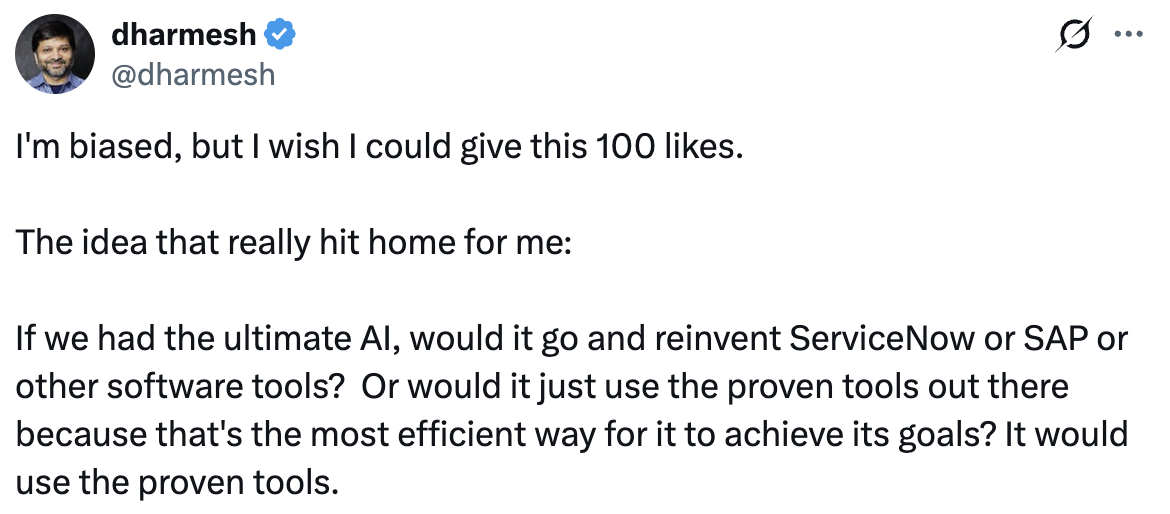
His answer: It would use the proven tools.
Yes, this seems obvious once stated, but the implications are profound.
As Dharmesh points out, if you have a 200+ IQ human join your team and you ask them to summarise sales in Europe last quarter, you don't want them to start "vibe coding" their own CRM. You want them to access the system of record, the tool that was specifically built for that purpose.
The same logic applies to AI agents. When an AI agent needs to know how many customers signed up last month, it shouldn't reason over reddit comments and internal emails to make its best guess. It should query the CRM and get the definitive answer.
Tool use was one of the biggest advancements in AI. Once we started giving AI access to tools, it became exponentially more effective.
But here's where it gets interesting: for AI agents to use existing software tools effectively, those tools need to expose themselves in agent-friendly ways.
When Anthropic launched Model Context Protocol in November 2024. The protocol was elegant in its simplicity, like a USB-C port for AI applications. Forward-looking companies immediately understood what this meant: they could build MCP servers to expose their tools, resources, and capabilities to AI agents.
Then came the extension: MCP Apps.
MCP Apps don't replace MCP servers, they enhance them. An MCP server is still the foundation that exposes your tools and data. But now, instead of returning only text or JSON, your MCP server can return interactive UI components.
Officially launched in late January 2026, with MCP apps, tools can now return interactive UI components instead of plain text.
Anthropic partnered with launch partners including Amplitude, Box, Canva, Clay, Figma, Hex, Monday, and Slack to demonstrate what this unlocks. The beauty is these aren’t AI generated approximations. They're the actual product interfaces, rendered as interactive components within Claude (or any other MCP-supporting AI client).
The product teams at these companies made deliberate choices about which data layers to expose. Amplitude focuses on their insights layer. Box emphasizes search and document preview. Each company is essentially asking: "What is the essence of our value when an AI agent is the interface?”
This is where Dharmesh's insight becomes critical for SaaS companies.
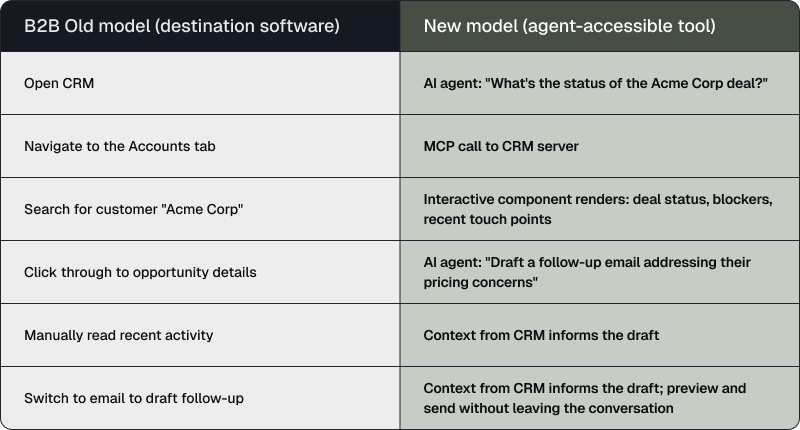
Nothing dramatically changes in the software. The CRM still manages customer data, enforces workflows, maintains data integrity. But the access pattern fundamentally shifts.
This is what companies are wrestling with as they build MCP Apps: What is the essence of our tool when an AI agent is the interface?
Looking at the launch partners' choices is instructive:
… and so on.
Each company made deliberate choices about which capabilities translate to agent-driven workflows. They're decomposing their products into:
So if the future is AI agents using proven tools via MCP Apps, what does it actually take to expose your tool this way?
This is where the gap between vision and reality becomes brutally clear.
Everyone gets excited about the strategic positioning to become the default tool that AI agents choose in your category. The product discussions focus on the exciting stuff: Which capabilities should your MCP apps expose? How do you design interactive components that render beautifully in Claude or ChatGPT? What workflows translate best to agent-driven use?
Essentially, before you can build MCP Apps, you need a production-grade MCP server that involves a complete workflow, from creating the tools, to hosting the server, to authentication, to governance.
The fundamental infrastructure problem is: How do you let thousands of different AI agents access your MCP server securely on behalf of millions of users?
Let me walk through what it actually takes to build a production-grade MCP server:
Most companies can handle steps 1-3, they're familiar engineering problems. Step 4 is where things get complicated, and it's what we'll focus on here because it's both critical and commonly underestimated.
Let me explain.
When your SaaS product is a traditional web application, authentication is well-understood. Users authenticate themselves with with credentials or SSO, sessions are maintained with cookies. Your security team has built robust integrations with Okta, Microsoft Entra ID, Google Workspace, and access control is based on user identity and roles.
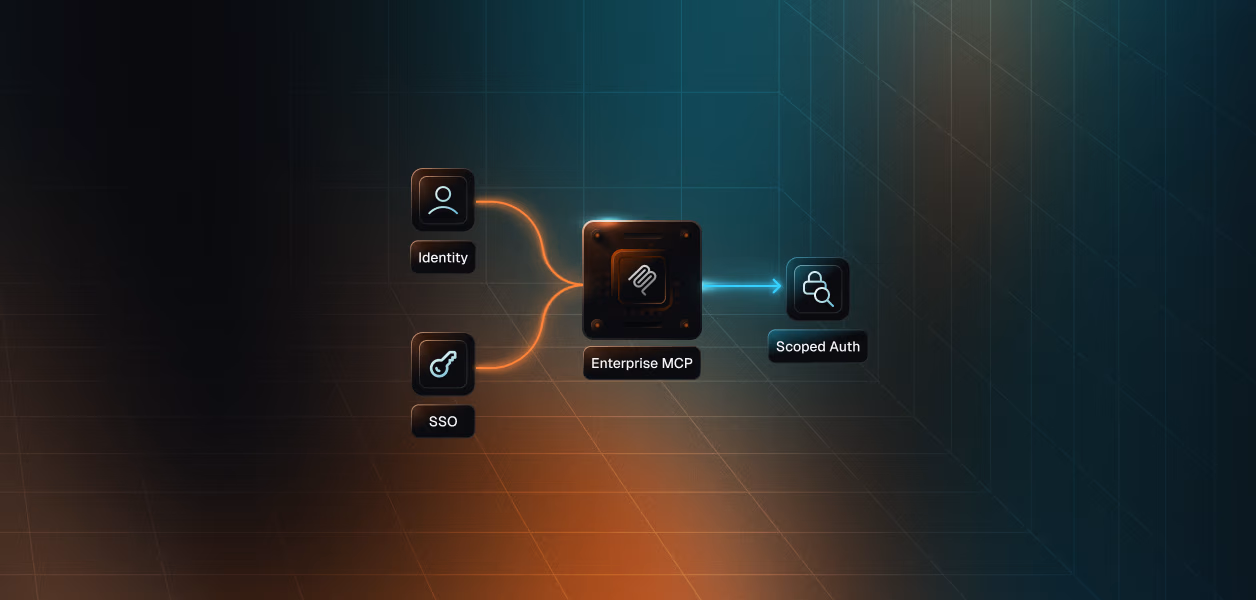
Related read: How enterprise MCP works along with SSO and scoped auth
This model works perfectly because you control the client; it's your web app running in a browser. But when your product becomes an MCP server that AI agents access, everything changes: The client is no longer your web app. It's Claude Desktop. Or ChatGPT. Or VS Code. Or Cursor. Or hundreds of other AI tools you don't control.
Each of these MCP clients needs to:
And your enterprise customers need:
This is a fundamentally different authentication model than most SaaS companies have built and it's table stakes for enterprise adoption of your MCP server.
Let me be blunt about what's happening: MCP Apps represent a massive market opportunity for companies that move fast.
But to capture this opportunity, you need to ship production-grade MCP servers first. And the companies that solve the authentication and authorization challenge quickly will have a significant first-mover advantage. Here’s where the “proven tools” thesis matters strategically: The companies with the best tools win in an agent-driven world.
Look at what’s happening already:
I strongly believe that the early movers in MCP Apps will establish themselves as the default tools in their category, because the network effects are powerful.
If you're running a growth-stage B2B SaaS company, here's how to get started to capitalise on the MCP Apps opportunity:
This creates a powerful reinforcement loop: more agent usage → better agent interfaces → more agent preference → category dominance.
At Scalekit, we're all-in on the agentic future. We're building the authentication infrastructure layer that makes secure MCP deployments possible. We handle:
Inbound auth flow: MCP clients and users accessing your MCP servers
Outbound auth flow: Your AI agents connecting to external tools on behalf of users
We have 100+ customers who deployed secure remote MCP servers in hours instead of months. We've built the infrastructure so they can focus on building great AI experiences instead of auth plumbing. And we practice what we preach, we've built our own Scalekit MCP Server so developers can manage organisations, users, and authentication connections through natural language queries in their AI tools.
Let me close with a prediction: In 12 months, we won't talk about "MCP Apps" as a separate category. We'll just talk about software. Every B2B SaaS product will have:
The question is: Is your tool good enough to be the one they choose?