May 6, 2026
AgentKit

Embed account connection anywhere in your product. No redirect to a hosted page required.

Users can connect their accounts inline in your product — no redirect to a hosted page. The Connected Account Widget and Actions Portal drop into any web surface, with Scalekit handling the OAuth flow and credential storage underneath.

The hardest part of embedding agent auth in a product isn't the OAuth plumbing — it's giving end users a way to connect their accounts without leaving your application. The Connected Account Widget and Actions Portal let developers embed a fully functional account connection UI in any surface, with Scalekit handling all auth state underneath.
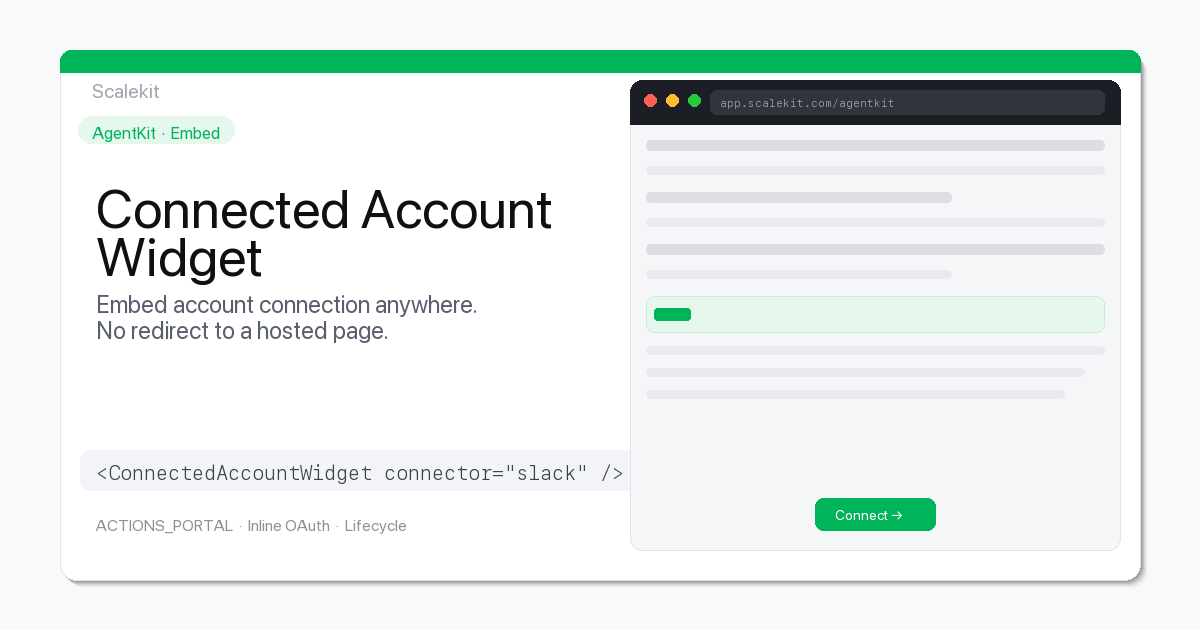
Connected Account Widget

An ISV building an AI-powered operations assistant wants users to connect their Salesforce, Jira, and Slack accounts inline during onboarding — not via a redirect to a separate hosted page. They embed the Connected Account Widget with a few lines of code. Users connect their accounts in place. Scalekit stores the credentials and the agent has immediate access.

For third-party portal scenarios: a vendor portal embeds the widget for a specific connector using the ACTIONS_PORTAL auth type. The enterprise end user connects from within the vendor's existing product surface — no context switch, no separate app required.

What ships with this

  • Connected Account Widget — embeddable component that drops into any web surface with minimal integration.
  • ACTIONS_PORTAL auth type handles portal-embedded account connection flows.
  • Test token tooling lets developers validate credentials without running a full end-to-end flow.
  • Disconnected status migration — connected, active, and disconnected are first-class lifecycle states.
Share on

Embed account connection anywhere in your product. No redirect to a hosted page required.

The hardest part of embedding agent auth in a product isn't the OAuth plumbing — it's giving end users a way to connect their accounts without leaving your application. The Connected Account Widget and Actions Portal let developers embed a fully functional account connection UI in any surface, with Scalekit handling all auth state underneath.

Connected Account Widget

An ISV building an AI-powered operations assistant wants users to connect their Salesforce, Jira, and Slack accounts inline during onboarding — not via a redirect to a separate hosted page. They embed the Connected Account Widget with a few lines of code. Users connect their accounts in place. Scalekit stores the credentials and the agent has immediate access.

For third-party portal scenarios: a vendor portal embeds the widget for a specific connector using the ACTIONS_PORTAL auth type. The enterprise end user connects from within the vendor's existing product surface — no context switch, no separate app required.

What ships with this

  • Connected Account Widget — embeddable component that drops into any web surface with minimal integration.
  • ACTIONS_PORTAL auth type handles portal-embedded account connection flows.
  • Test token tooling lets developers validate credentials without running a full end-to-end flow.
  • Disconnected status migration — connected, active, and disconnected are first-class lifecycle states.
Schedule a demo with Scalekit today.